Long Form Roleplayers
Established: 2021-04-21
Chat room: #long_form
- Long-term roleplay
- Descriptive writing
A space for fans of descriptive, long form roleplays of all genres to meet and greet one another

AFTER THE END
The plain stretched as far as the eye could see, covered with fine ash that the wind swept endlessly, as if it were seeking to bury the earth under a final layer of silence. The trees, when there were any left, rose naked, emaciated, their branches twisted in gestures of supplication towards a sky too low, of an uninterrupted gray. The sun, if it still existed, remained hidden behind this cloak of mist and dust, a dead star whose memory alone still illuminated the ruins of the world.
In the distance, a line of mountains could barely be seen, blurred contours in the thickness of the air. Closer, metal carcasses slept half-buried in the cracked ground, vestiges of an age when man believed he had triumphed over everything. Their corroded forms drew a cemetery without a name. No bird, no cry, not even the murmur of a river. Nothing. Only this dull, obstinate beat of the wind against the dead matter of the world.
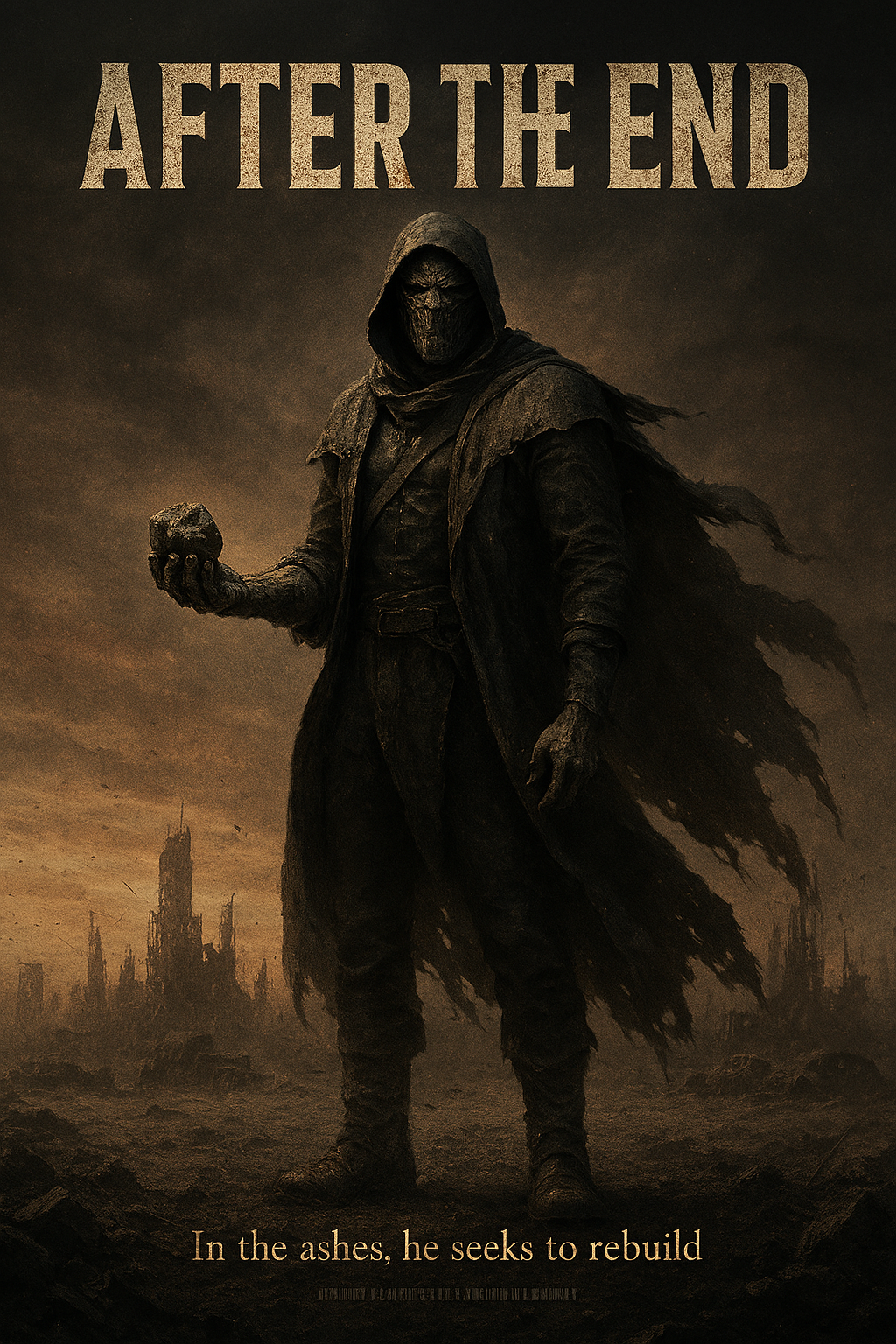
He was advancing slowly, a shadow against the burnt horizon. His heavy step dusted the dust, leaving traces immediately erased by the wind. The man was tall, his body knotted under layers of gray fabric and soot. His shoulders, broad as those of an ancient burden, bore a torn canvas bag from which the wood of an improvised weapon protruded. His face was not visible. A black hood went down, a cracked leather mask covered the rest. One might have thought that he had no face, that he was just a presence among the ruins.
Nothing in his pace betrayed fear or haste. He advanced with the regularity of a metronome – without apparent purpose, perhaps without hope. At times, he stopped to scrutinize the emptiness in front of him, as if he were looking for some trace of a world that could have survived. But there was nothing, except the wind, the cold, and that thick silence that no word had any longer the right to break.
He resumed his walk. Each step seemed to bring him closer to something of which he did not know the shape, but that he knew was inevitable.
He stopped. The wind slithered along his coat, lifting a little ash around his boots. In front of him stretched a field of ruins, broken silhouettes of collapsed buildings, sections of cracked walls, twisted metal bars that rose like bones out of the ground. Nothing moved. The silence weighed there like a matter.
And yet, under his dust-covered eyelids, he still saw something else: the avenues, the lights, the movement of the crowds before the end. The whisper of human language, the forgotten faces, the warmth of an ordinary life—all this returned in splinters, like reflections caught in the broken glass of windows. The smell of bread, a child’s laughter, the rain on the asphalt. Images suspended between two ages, fragile, impossible to remember.
He knew where he was. Here, once, lay a city. His name had faded, but the ground still murmured it to those who wanted to hear it. The man placed his hand on a black stone and remained there for a moment, motionless, as if he could feel the ancient beat of the earth under the ash.
He closed his eyes. The wind almost stopped, as if bowing to the memory. Then, the images arose: brutal, exploded, impossible to contain. The sky torn by flames, the cries stifled in the smoke, the glow of the towers that were collapsing one by one. He saw himself standing in the middle of the tumult, his own burning gaze from this cold certainty that precedes destruction. And all around, what he had wanted to extinguish — the rumor of the world, the stubborn life.
He had believed that disorder would be a just end, a purification. That from the fall something else would come, more true, purer. But in the reflection of his memories, there remained only ashes and blood mixed together, the material of a fault too great to be named.
When he opened his eyes, the landscape seemed even emptier to him, as if the world itself was moving away to flee from it. The wind resumed, raising the dust of what it had struck.
He remained motionless for a long time, his eyes lost in what was only a field of ash. All around him bore the mark of his hand, invisible but certain: the split stones, the overturned towers, the sterile ground that no seed wanted to cross anymore. He felt the weight of it pressing against his chest, slowly, like a remorse that took shape.
He now remembered everything. Anger first, pure, nameless: this inner fire that he had thought he was controlling and which one day stood up against the world. Then the fury, unleashed like an ancient beast, extending beyond his will. He had shouted, struck, annihilated what had carried him. And in his rage, he had seen neither the faces nor the supplications—only a blind need to erase.
By now, that dead energy was still living within him, lurking in his rib cage, rumbling faintly like an echo of disaster. He lowered his head; his fists clenched without him realizing it. The wind, passing between his fingers, seemed to whisper the names of those he had lost. Of those he had destroyed.
He remembered them. Not their faces first, but their gestures: a hand resting on his shoulder, a brief laugh in the morning light, the timbre of a voice he thought forgotten. All these fragments that once made a world. Then the images became clearer, and the pain returned with cruel clarity. They were there, around him, confident. They had followed him without understanding the abyss in which he was leading them.
He had offered them. Not all at once, but slowly, through small betrayals. A promise kills here, a lie concealed there. He had thought himself different, more lucid, stronger—but all that was only his own desire disguised as necessity. When the end had come, he had already consumed everything: their lives, their trust, their warmth. He had used them as fuel to feed his own flame.
Now only their absence remained, planted in him like nails. Every memory carried the bite of shame. He saw them fall, one by one, into the blaze of his own choices. And he then understood that it was this, the true price of his survival: to walk alone in a world devoid of love, haunted by the shadows of those he had delivered.
He knew it. For a long time, he had already known it, but he had to lose everything for this certainty to fester in him. Nothing would come back. Neither their voices, nor their faces, nor the warmth of their steps behind hers. The world returns nothing that is taken from it. What is consumed remains ash; no forgiveness germinates on a burned ground.
He had tried, in the past, to imagine a return, a chance of fate that would bring their shadows back into the light. But this idea had gradually deserted him, replaced by a void more solid than stone. There was no longer any miracle to wait for: only the long silence that follows the crash, and this endless road where his steps weighed more than his body.
Since then, he no longer spoke to anyone. He was moving forward because he knew nothing else to do, carrying within him not the memory of his friends, but their absence—like a scar that one must not touch, for fear it starts bleeding again.
His face was also part of what he had lost. In the past, it had a name, a shape, a reflection that others recognized. But it belonged to the old world, the one he had burned with his own hands. When everything had collapsed, the fire had not been limited to stones and men: it had sought its skin, its identity, as if to sign the price of the disaster.
He remembered the moment — a white light, brighter than daylight, the warmth that closed in on him, a roar that was neither human nor divine. Then nothing more, except the taste of metal and dust. When he stood up, what remained of his face was only a bare surface, welded, without features. The world had taken back his appearance so that he no longer had to contemplate the one he had become.
Since then, he has been wearing this leather mask, not to hide from others, but to protect himself. Under this dry matter, there was neither an expression nor a smile. Only the burning memory of the moment when his humanity had been torn from him with skin.
He now understood that he could not rebuild anything identical. The past belonged to dust, and no effort, no faith, could give it body again. The disappeared cities, the voices he had loved, all this rested in a closed time of which only shadows remained. Yet, the world, even broken, continued to turn. The wind was blowing, the clouds were passing. And in this movement, he felt the tenuous possibility of something else: not a redemption, but a persistence.
He would never again be the one he had been. His deformed face, his inner and visible wounds would remain as so many signs that had to be worn, not erased. He knew that living from now on would consist of coexisting with the evil he had done, to walk every day in the gray heath with no other purpose than to still exist.
Then he raised his head, and for the first time in a long time, he looked ahead without fear. The earth had nothing more to offer him, but it claimed his presence. And he understood that it was perhaps there, in this simple act without glory—continue despite everything — that peace began.
The day fell slowly, wiping the sky in shades of copper and soot. The man walked, a unique figure in the gray plain. With each step, the light receded, but it left behind a persistent glow, suspended on the horizon like a breath that refused to die.
He stopped at the edge of an old road, half choked with dust. The silence around him was no longer threatening. He now looked like a waiting, calm and almost tender. He plunged a hand into the dry earth: under the layer of ash, he felt a different texture, still warm, alive. It was almost nothing—a wet dust, the promise of renewal.
He remained there for a long time, motionless, his gaze fixed on the distant line where the world seemed to start again. And in this twilight without certainty, he knew that he would continue to walk. Not to forget, nor to redeem oneself, but simply to be there when something even imperceptible—would dare to bloom again.
The wind rose gently and carried a handful of ash towards the sky.
And the man, for the first time since the end of the world, closed his eyes without fear.
He knew that friends would not return. Nothing could erase the furrow he had dug in the memory of the world. The hatred he had sown remained lurking in the ashes, old and tenacious as dust. Yet, he had returned. Not to seek glances, nor open arms. He did not want forgiveness. Only a place to lay one’s hands, a stone to raise, a trace of life to revive.
He was advancing in what remained of a village, amid cracked walls, glass-free windows, collapsed roofs. The marks of the past were everywhere, but the silence was no longer that of despair—only that of a world waiting to be touched again.
He dropped his bag, knelt down, picked up a stone still cold. She weighed heavily, but he kept her against him as a first gesture, perhaps insignificant, but true. In this weight, he felt the rhythm of his own breathing. He no longer hoped for anything: only continue, build despite everything, even alone, even in the rubble.
Then he began to work. And as his blackened hands touched the stone, something—tiny but real — changed in the air. The day flew by, and under the gray sky revived the fragile idea of a beginning.
THE END
Published: 2026-02-20, viewed 23 times.