THE HIGH TABLE
Established: 2023-11-17
Chat room: #BARBARUS
- No holds barred
- Weapons
- Extreme violence
- Blood
- Death
A worldwide organization of men trained for violent, bloody, and even deadly combat. Their competence is indicated by their qualifications, from the lowest to the highest, reserved for an elite.

THE ALLEY

In an era when public order seemed to be faltering under the subterranean pressures of human passions, a place had sprung up in Paris, in a neighborhood unknown to casual passersby but familiar to those in the know, whose reputation was whispered about with the feverish excitement of forbidden things. It was neither a salon nor a theater, yet people flocked there with a fervor that would have made the boxes at the Opera blush.
The crowd, growing ever denser despite prefectural decrees and the dissuasive patrols of the police, squeezed between the damp walls of an old warehouse, accessed by a narrow, damp staircase that oil lamps struggled to illuminate. Those who descended there were not seeking entertainment—they were seeking thrills, that exquisite turmoil that blood awakens in the souls of civilized people.
The seats, few and wobbly, formed a semicircle around a sandy circle—a primitive arena, a silent theater of struggling bodies. There, social refinement seemed suspended. The industrialist's tricorn hat rubbed against the worker's cap; the lace of the Duchess of Rapounard brushed against the worn fabric of the grisette; and all, whether born in gilded luxury or clay, shared the same look — a sharp, primitive gleam, the spark of a desire that the century pretended to forget.
One entered there as one enters a secret. The walls permeated their visitors with a rancid smell of gunpowder, sweat, and stupor. It was not a crime to come. But it was a transgression. An escape from social veneer, a parenthesis where muscle spoke instead of language, and where violence, staged, took the place of ultimate truth.
During the previous fall, a young man with a discreet gaze but gestures full of that noble awkwardness that betrays the provinces had crossed the threshold of the capital with a feverish soul: Gaspard d'Aubrives, son of a notary from Limoges ruined by reckless speculation. Having come to study law in the austere lecture halls of the Faculty, he still wore the provincial cut of his clothes and carried in his dreams the naive enthusiasm of souls far removed from Parisian intrigues.
His classmates, young people born in the hustle and bustle of the boulevards and well versed in the customs of masked balls, took pleasure in introducing this newcomer to the adulterated delights of the capital. Gaspard, docile and charmed, had tasted the Opera—an ephemeral temple where beauty is sold by the hour—strolled along the Boulevard du Crime in search of the thrills of transgression, and entered—often without his knowledge—the boudoirs and back rooms where the golden youth consumes itself in pomp and vice.
But on that day, his friend Théodore Bichonnet, an ambitious young man with a neatly trimmed moustache, whose words betrayed both his working-class origins and his calculating nature, promised him an even rarer, more secret adventure: clandestine fights, those forbidden spectacles that gentlemen whisper about and ladies evoke with a shiver. Gaspard, his heart racing, was about to descend, not toward science or law, but toward the dark arena where humanity reveals itself in sweat and violence.
The room into which Gaspard d'Aubrives descended seemed removed from the civilized world—an underground recess where the laws of the century gave way to primal urges. The air was heavy, impregnated with an animal dampness, as if the walls had preserved the sighs, cries, and smells of past confrontations. No sooner had his boots touched the sandy ground than his gaze clouded over. There was something ancient about the place, a reminiscence of Roman games, a scent of decadence turned into spectacle.
Around him, frozen, tense faces reflected the same intensity—the profiles of haughty duchesses, the faces of short-winded porters, all equal in their anticipation of the outcome. Gaspard couldn't help but scrutinize each of them, as if to understand what need had brought them together in this abyss. A hoarse voice rose from a corner of the shadows: “It's over! He's fallen...”

On the sand stained with blood and sweat, a man lay, his chest heaving with erratic gasps, while the other, massive, his fist still clenched, walked away without a glance. The defeated man, whose suit was nothing more than a tattered rag, wore in his eyes the silent expression of defeat—not that of the body, but that of dignity. And Gaspard, until then a novice spectator, felt a confused emotion welling up in his chest: both fascination and repulsion, as if the soul of Paris, in all its ambiguity and depth, had been revealed in this fight.
He had thought he had come to watch entertainment, but he understood, in the silence that followed, that he had just glimpsed a harsher truth: the one that links refinement to brutality, the one that whispers that beneath the silk and science, man remains an animal—capable of poetry, certainly, but also of fury.
As the murmurs died away, giving way to an almost sacred tension, the combatants of the second fight made their appearance, sending a shiver through the ranks of the compact assembly.
First, there was silence—the kind that precedes things we dare not believe are real. Then, as if emerging from the depths of a myth, the Jamaican giant appeared, a vision of raw power. His imposing figure, over six feet tall and weighing 290 pounds of sculpted muscle, stepped forward into the dim light, wearing nothing but a linen loincloth tied at the waist. Each step seemed to make the ground vibrate, and his dreadlocks, long as forgotten promises, swept across his shoulders tattooed with strange symbols—spirals, wild beasts, mystical verses. He looked like a figure drawn by Géricault, a colossus escaped from a nightmare or an epic.
Opposite him, more modest in stature but radiating a sharp calm, entered the Parisian worker, bare-chested, his gaze straight and hard, his jaw clenched like that of the statues of the Bastille. His muscles, chiseled by tools and labor, bore the brilliance of the suburbs: not that of salons, but that of coal and revolt. He was well known here—Marcel, known as “The Chiseler”—and his simple name whispered among the ranks triggered a wave of respect mixed with fear. He was the undefeated champion, the favorite of the hall, the man whose blows crushed hopes and whose silence weighed heavier than a speech.
Gaspard, torn between fascination and incomprehension, didn't know what to make of this opposition. Everything about the Jamaican's stature suggested crushing force. Everything about the worker's posture whispered victory. It was a clash of worlds, an almost metaphysical contest: the foreign against the familiar, chaos against order, enigma against legend.
The sand beneath their feet prepared to drink again.
Gaspard d'Aubrives' gaze clung to the Jamaican's body as one clings to a vision that one senses will change something within oneself. As the two combatants silently observed each other in the arena, a strange fog seemed to envelop the young provincial's consciousness, drowning out the clamor around him and leaving only the overwhelming presence of the giant.
The flickering light glided over the newcomer's bulging muscles as if over living marble. Each tattoo—a coiled snake, a primitive spiral, African glyphs—evoked a story that Gaspard did not know but guessed was ancient, violent, and sacred. Dreadlocks framed the man's face like a wild crown, and in his eyes burned a serious, almost mystical glow. It wasn't hatred. It wasn't rage. It was something else — a calm intensity, the restrained fire of an inner world that the crowd couldn't understand.
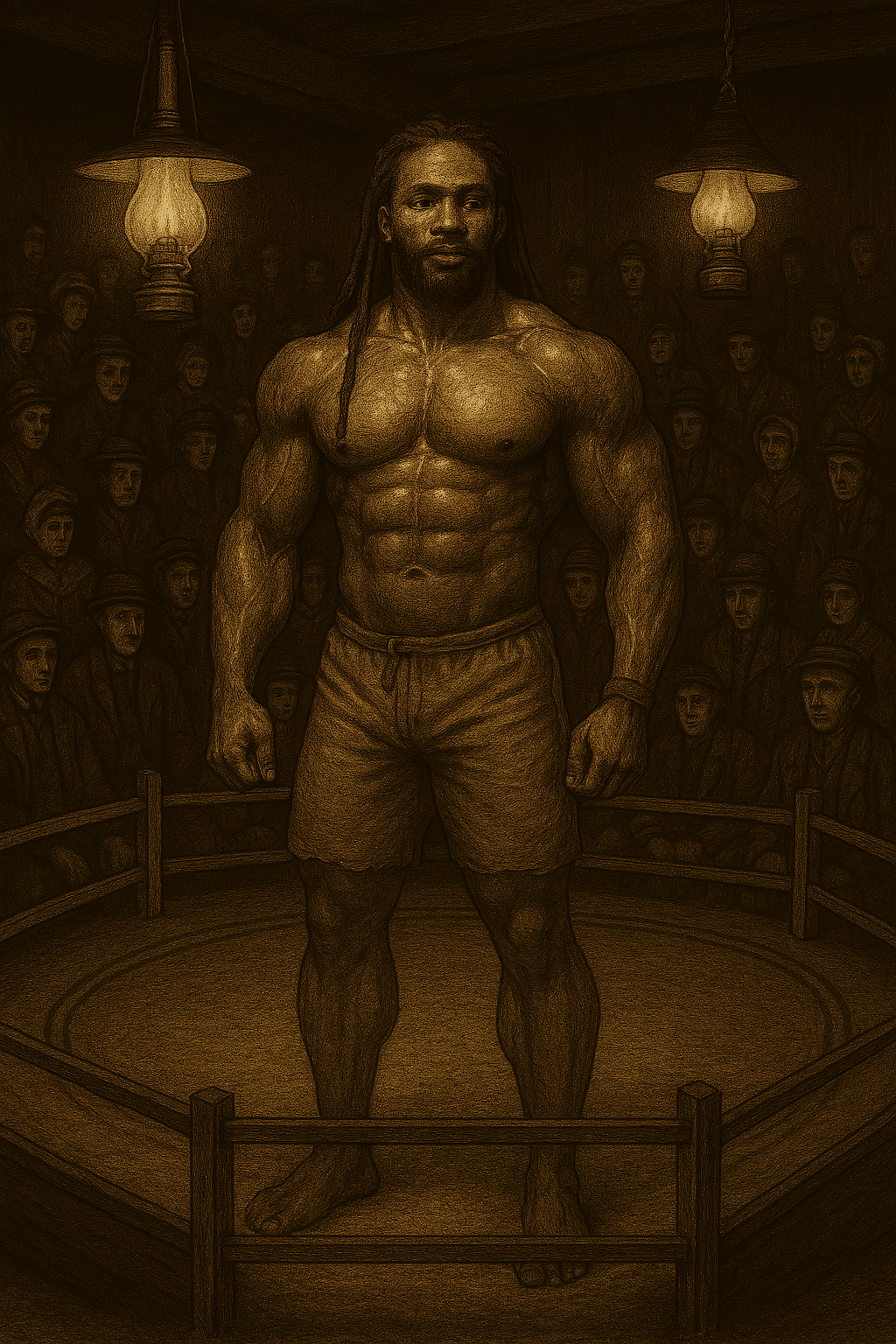
Gaspard, steeped in the morality of his legal readings and the bourgeois education of Limousin salons, felt something old crack within him. This body standing on the sand, this raw embodiment of strength and mystery, aroused in him a disturbing fascination, as if the man, by his mere presence, were challenging the established order. It wasn't just his appearance. It was what it said about the world: that beyond convention, there were entire lives sculpted in pain and silence, men who didn't ask to be liked—but to be seen.
Next to the Jamaican, even “Le Ciseleur,” the Parisian worker, suddenly seemed too familiar, too explainable. As the first blows were exchanged, brutal, precise, almost choreographed, Gaspard was not watching a melee. He was contemplating a clash of symbols, and his heart, despite himself, was beating for the unknown—for this half-naked colossus, bearer of vertigo.
He did not yet know why. But he knew that this thrill—this attraction—was not only physical. It was a thirst for another world. And it had just been embodied before him.
The sand, still warm from the previous battle, seemed to hold its breath. Marcel, known as Le Ciseleur, lunged forward first, as swift as a blade drawn from its sheath. His body, sculpted by years of hard work, danced with brutal precision: dodging, attacking, feinting, striking. He mastered the codes of this place like a craftsman masters his tools—every movement was measured, thought out, effective.
The Jamaican, massive, remained almost motionless, responding to the assaults only with slight shifts of his feet, barely perceptible movements of his shoulders, as if the turmoil around him were nothing more than a wind to be ignored. With each blow delivered by Marcel, the crowd roared. The champion seemed to float above the arena, finding weaknesses and pushing his opponent back step by step. Gaspard, breathless, thought he already knew the outcome.
But then, in a moment that seemed to hang suspended in time, the black mass unfolded.
An uppercut—no, a burst of energy. The Jamaican, who had been holding back until then, pivoted his torso with calculated slowness, gathering telluric force in his loins and shoulder, and struck. It wasn't a blow. It was a decision. A sentence. The fist struck like lightning on the Parisian's solar plexus, lifting him off the ground with an almost majestic brutality. Silence fell. Marcel staggered. Then he collapsed, his arms open as if to embrace a defeat he had not anticipated.
For a moment, no one moved. Even the Jamaican remained frozen, his gaze fixed beyond the defeated man, as if searching for something in the depths of the place. Then he stepped back, calmly, like a statue being returned to its pedestal after an exhibition.
Gaspard, his heart pounding, his eyes burning, saw only one man—the one who had defeated without anger, struck without hatred. He didn't understand everything. But he knew he had just seen truth incarnate. And that truth had dreadlocks, a loincloth, and a silence more eloquent than any speech.
The silence that followed the final blow was almost mystical in its intensity. One might have thought that time itself had stopped, intimidated by the power it had just witnessed. But little by little, like a receding tide, the crowd came back to life.
A shiver ran through the uncertain stands, escaping from the throats of the spectators like a breath of catharsis. It was not a cry of victory—no, what Gaspard felt around him was neither joy nor acclamation. It was silent, raw admiration, enveloped in a shared vertigo. The audience, this diverse society mixing satin and sweat, no longer knew quite what it was watching: a simple fight or a revelation.
Eyes met, feverish, troubled, some illuminated as if by a biblical revelation, others tinged with fear, as if this Jamaican had just reminded everyone that there were forces beyond convention, men from elsewhere capable of shattering certainties. Free men.
A duchess, wearing an overly heavy necklace, slowly raised her fan as if to hide a shudder. A butcher's boy from the Faubourg sneered nervously, his palm sweaty. Even Théodore Bichonnet, though accustomed to such jousting, remained speechless for a moment, as if doubting what he had just seen.
And in the midst of this contained turmoil, Gaspard d'Aubrives felt something strange, almost shameful in his world of moral balance: a deep exaltation, a dazzling sensation. As if this naked, tattooed giant, standing in the middle of the red sand, was silently revealing to him that boundaries only existed in the eyes of the beholder. Gaspard no longer saw a body. He saw an enigma. A promise. A crack in his universe.
The end of the fight unfolded like an afterthought, with the pulsing of bodies still seeming to reverberate within the walls. The Jamaican, his chest covered in sweat, his dreadlocks dripping, and his gait noble, slowly emerged from the room toward the dark hallway leading to the street. There, the crowd had gathered—a strange mix of onlookers, knowledgeable fans, women veiled in shadow, and gentlemen wearing gloves. There was no more whispering; everyone was watching. The silence was no longer respect, it was desire.
Gaspard, still on the verge of vertigo, slipped between the silhouettes, his heart beating with an ardor he could not name. He had never been one to push through crowds—but something, a gentle and irresistible force, was drawing him toward this man who seemed to carry within him all the power of forgotten worlds.
The Jamaican, standing under a flickering lantern, exchanged a bored glance with a man dressed in plum velvet, arching his back in his patent leather boots, wearing a pocket watch and a calculated smile: it was the Duke of Lancy-Mireveau, a discreet figure in the Marais, known for his aesthetic tastes as refined as they were scandalous.
“You are a masterpiece, sir,” he said in that starchy salon voice. “I can assure you a comfortable income. It is not a question of making you fight again. It would be a question of... admiring you more closely. Of possessing you.”
The sentence fell like a gentle insult. It was spoken with the refinement of those who buy without shame. The duke held out a heavy purse with a gesture that could have been mistaken for gallantry.
And something broke in Gaspard's heart. He did not yet understand whether it was jealousy or a more intimate, more abysmal feeling. But the idea that this man, this titan, could be reduced to a transaction awakened in him a tightness, a silent pain, almost too great for his young man's chest. He had thought he was seeing a god, and now he was being bought.
The Jamaican slowly lowered his eyes to the gold, then to the duke. He said nothing. But Gaspard, in his confusion, thought he saw a shadow pass over his gaze. A kind of weariness, a crack.
The Jamaican, still standing in the flickering light, lowered his eyes to the purse held out to him by the Duke of Lancy-Mireveau—that bag of golden promise, of domination masked beneath the lace of luxury. He contemplated it for a brief moment, as if weighing not the metal, but what it represented: the purchase of a body, the appropriation of a mystery, the erasure of dignity.
Then, without a word, in a slow, deliberate gesture, he took the purse between his powerful fingers. And in a choreography of silent contempt, he raised it above his head, before throwing it to the ground with a thud that made even the stones jump. The coins rolled between the feet, bursting like confessions in the dust.
The duke blinked, as if this refusal had not been anticipated in the economy of the world. A nervous laugh escaped from a nearby throat, quickly stifled by general discomfort. The giant slowly turned his head, scanning the assembly with his gaze. And suddenly, everyone looked away, as if struck by a truth too naked to bear.
And Gaspard...
Gaspard felt a dull fire in his chest, a tremor. He did not know that rejection could be so grandiose. This throwing of the purse was more than a refusal—it was a statement. A work of art. The act of a man who did not bow down, who restored gold to its vulgarity. Gaspard was overcome by an emotion he could not name, a mixture of admiration, relief, and a turmoil so deep that he almost forgot who he was.
What he had just witnessed would not be taught in lecture halls. He would not read about it in textbooks. It was a moment of raw, untamed human truth, and Gaspard knew that his world had just been turned upside down. A discreet tear lingered on the edge of his eyelashes—not from sadness, but from the tragic beauty of a refusal he had never been taught to imagine.
The crowd's departure was like an ebb tide, slow, organic, marked by murmurs and the rustling of fabric. The spectators, either satisfied or shaken, evaporated in silent clusters toward the stairs, as if the fight had left too deep an impression on them to discuss it aloud. Even the loudest, the ones accustomed to speaking their minds, seemed held back by an invisible veil—the modesty born of the sublime.
Gaspard remained there, motionless, at the edge of the sandy circle, while the lanterns went out one after the other, leaving only a few whitish halos and the warm breath of the place. Theodore had tried to call out to him, a mocking remark ready to burst forth, but he received only a vague gesture, a polite sign of distancing. Then he left, leaving his friend alone in the darkness.
And Gaspard, his heart beating with feverish hesitation, made his way to the hallway where the Jamaican was still waiting, sitting on a crate, his elbows resting on his knees, his head bowed in a meditation that seemed older than the world itself.
The young man felt each step was a daring one. He didn't know what he was looking for: a word, a presence, a spark. But he knew, with the clarity that only comes in defining moments, that he couldn't leave without trying something.
He approached slowly until the giant's shadow enveloped him.
“Sir,” he said at last, his voice trembling but clear. “What you did tonight... what you refused... it was...”
He didn't finish his sentence. The Jamaican raised his head. His gaze was calm, deep, free of all tension. He looked at Gaspard without hostility, as one might look at a visitor in a dream.
“You're not from around here.” His voice was deep, calm, almost gentle.
Gaspard nodded. “No. But I think I've been looking for this place for a long time.”
Silence united them for a moment—not as strangers, but as two fragments of the same secret. And in this hallway, which was nothing like a temple, something opened, silently, like a page that no one dared to write on.
Under the flickering neon lights of the backyard, a strange gentleness settled in. The Jamaican slowly straightened up, his gaze still fixed on Gaspard, as if he were gauging not the young man, but the intention behind his gestures.
“Would you like to take a walk?” he asked. “There's a quiet alley behind here. It's easier to breathe outside.”
Gaspard nodded without thinking, driven by a kind of impulse that was neither curiosity nor courage, but something in between. The feeling that an invisible thread was pulling him toward something meaningful.
They went through a discreet side door that led to a maze of damp stones and walls decorated with old graffiti, like frozen whispers. The air was cooler there, heavy with the smell of metal and withered leaves. The silence was not that of emptiness, but of places waiting to be spoken to.
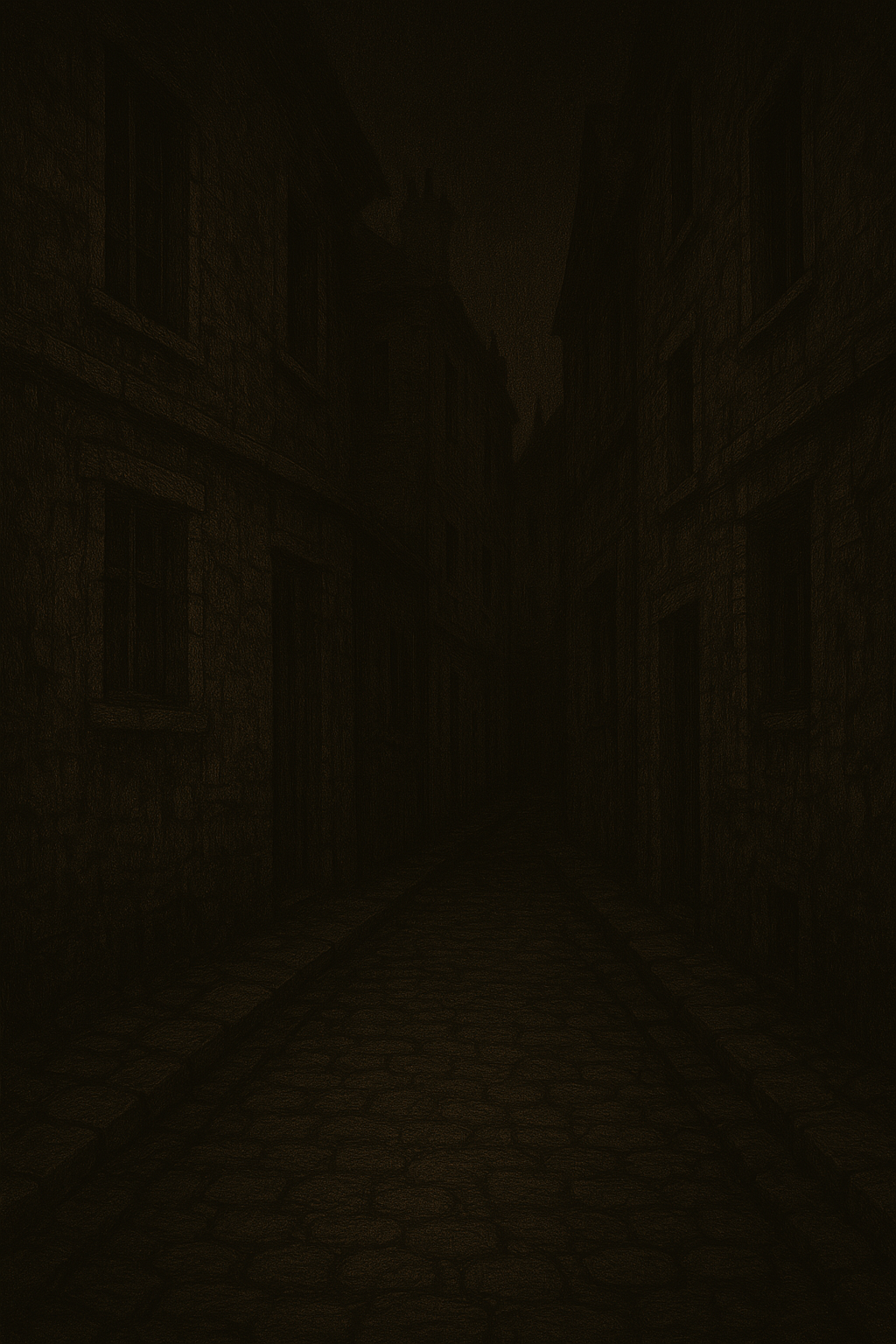
The Jamaican walked slowly, his body seeming to absorb the night like a dense fabric absorbs light. Gaspard, at his side, observed his simple movements, the way he avoided puddles, how his steps were taken with an almost spiritual restraint.
“You know,” said the giant without looking at him, "it's rare for someone to stay after the show. They take in the glitz and leave. But you... you saw something else. You looked behind."
Gaspard remained silent for a moment, then replied in a low voice: “I think I saw what I didn't yet understand. And what I want to understand.”
A discreet smile stretched the Jamaican's lips.
“Then walk with me a little longer. There are truths that cannot be found in the spotlight. They live in the alleys.”
Their bond was not established through words, but through the way they walked side by side without rushing. Gaspard felt less like an intruder and more like a piece finding its place in a forgotten puzzle.
And at the corner of a wall tagged with “Dare,” the Jamaican stopped and turned to him.
“You want to know why I refused to hit him? Why I stood still?”
Gaspard's eyes sparkled, not just with anticipation—but with a new thirst.
There they were, the two of them, under the crackling lantern, in this deserted alley where the world seemed suspended. The Jamaican leaned against the decrepit wall, his breathing still heavy, not from physical fatigue, but from a weight older and more buried.
“You know,” he said, his voice rough but low, “what I threw away tonight... it wasn't the first time it had been offered to me. But every time, it's as if I'm being asked to sell myself, not my body—that I can take—but what keeps me going inside. What I've kept intact. My fire.”
He ran a hand over his chest, where the tattoos intertwined. His gaze lost itself in the darkness of the sky.
"When I was a kid, they called me ‘the beast,’ not as a compliment. I grew up without a name, without rights. I was taught to fight to be seen. And now that they see me, they want to buy me. As if being seen was the price they had decided on. I refuse that. I'd rather die in the mud than become their trophy."
Gaspard, frozen, felt a slow jolt inside him. The story, simple, almost raw, awakened in him a pain he had never known before: the suffering of worlds that are only hinted at, the invisible violence that shapes men beyond the spectacle. He now understood that the fighter's gesture—his rejection of the purse—was not just a matter of pride. It was vital. It was a refusal to be erased.
And in the eyes of this giant, Gaspard no longer saw brute force. He saw a wound. A wounded dignity. A loneliness.
“I'm sorry,” he whispered, “what you said... I feel it. I can't fully understand. But I... I think I want to learn.”
The Jamaican slowly turned his head toward him. He didn't answer right away. Then, in a calm voice:
“Then stay a little longer. It's rare to find a gaze that doesn't seek to possess.”
In the night, their silence was now complicit. Not the silence of misunderstanding, but that of recognition. And Gaspard knew that something had just begun.
The night seemed to hold its breath.
In that suspended moment, when words had fallen silent and only glances spoke volumes, Gaspard felt a stirring within him—something unexpected, burning, transformative. It was not merely desire, nor even wonder at the man he had learned to listen to. It was an older fire, a sudden surge of energy that made his chest, his throat, and even his fingers vibrate, a fire of rediscovered identity.
He moved forward slowly, as if each step were a victory over years of fear, of things left unsaid, of social inertia. And in this momentum, he was not only moving toward the other man, but toward himself, toward what he had long rejected, hidden, ignored.
Gaspard reached out, touched the Jamaican's shoulder—a calm mountain—and in that contact, a warmth flowed. As if the man in front of him were not a wall, but a door. A promise. A threshold.
The fire intensified. It was not raw passion—it was awakening. Every cell in him seemed to remember its capacity to love, to give itself, to take the risk.
And as he leaned in to kiss her, the fire did not burn. It illuminated. It consumed the old masks and gave way to an unarmored truth.
The Jamaican, motionless, his gaze fixed, did not back away. He welcomed this approach as one welcomes a shooting star—rare, intense, fragile.
And in this silent blaze, it was not a classic love scene. It was a ritual. Two solitudes were inventing a language.
The night enveloped them like a trembling canvas.
Gaspard's body trembled—not with fear, but with burning anticipation. Until that night, he had been an observer: of his own life, of his restrained impulses, of his desires that society camouflaged under layers of norms. But the man in front of him, massive, alive, embodied, had pierced his defenses. Not by force. By truth.
The Jamaican approached, his movements powerful but measured, as if he knew that tenderness could coexist with strength. His arms encircled Gaspard, who suddenly felt lifted out of the world—out of doubt. Their breath mingled, their skin sought each other out, found each other.
It wasn't just desire: it was the will to rewrite the laws of the body. To transform fear into fire, restraint into movement, abandonment into affirmation.
Gaspard, a virgin until now, was not a blank page: he was a closed book. And that night, this gentle but passionate giant turned the pages carefully—and passionately. Each of his caresses, each of his touches, revealed a new language, a new breath.
Their bodies finally spoke a truth that words could not contain. It was a clash of galaxies, a dance of fire and water, a first time that seemed to come from a thousand lives.
And when they finally came together, it was intense. Yes. But above all, it was right. The walls of the alley witnessed not just a carnal act—but a recognition. That of two souls in search of incandescence.
In the alleyway that, moments earlier, had been the setting for a truth laid bare, a sharp noise split the night—the sound of police boots, the sound of an order that tolerates neither drunkenness nor exception.
Stupor followed ecstasy.
Gaspard sat up abruptly, still feeling the burning wave that had washed over him. But the torch being brandished, the shouts, the chains being brought out—all of this burst the bubble. The Jamaican, standing naked, exposed like an overturned monument, did not move. His gaze sought neither forgiveness nor help. He knew.
The captain's words rang out:
“Indecent exposure, but above all... this man is not free. He is wanted. A fugitive. A slave.”
The world suddenly seemed to turn upside down. This was no longer the France of discreet passions—it was the France of chains, papers, and ruthless rules. And Gaspard, his fists trembling, felt the fire of a moment ago turn to ice. He wanted to speak. He wanted to say “no.” But his position, his condition, his fear... crushed him.
The Jamaican was chained with cruel slowness.
Not like tying up a criminal. But like locking up a symbol. The metal on his skin was an insult—and an admission. Even after that sublime night, the world brought them back to reality: one must not love, and the other must not exist outside the cage.
Gaspard stepped back. He lowered his eyes. And in that gesture, in that absence of a cry, he felt a shame even more powerful than that of forbidden desire: the shame of having let it happen.
But the Jamaican, walking away under escort, turned his face one last time. And in his eyes, there was neither rage nor reproach. Just an almost tender light—as if he were saying: I understand. You didn't know. But you will.
Years passed, but the alley never left his memories.
Gaspard became what was expected of him: a name mentioned in salons, a respected mind, a brilliant career. He had learned to speak without trembling, to charm his audience as one charms a crowd. But behind his speeches, behind the official portraits in gilded frames, there remained a darkness. An intimate truth, almost broken.
The Jamaican had become a vivid absence.
He never knew what had been done to him. Transferred? Deported? Chained for good in the workings of the empire? The archives were vague—perhaps deliberately so. At first, he searched. He wrote. He asked questions. But the answers slipped away like sand through his fingers. And the world, in a hurry, whispered to him: You have to move on.
So he moved on. But with a flaw.
In his silences, in his sleepless nights, in the furtive glances he cast at the silhouettes he passed — he searched. Not for a face, but for a fire. The one he had seen burning without shame, the one that had taught him that love is not always sweet: sometimes it is a struggle. A struggle between two people.
He became a man admired, but never truly whole.
He loved, sometimes. But not like that night. He had successes, partners, even accolades. But none of them carried within them that old burning — that mixture of indomitability and raw tenderness that the Jamaican had offered him, just before being torn away.
And deep down, Gaspard knew: it wasn't love he had lost. It was courage. The courage to intervene. The courage to say no. The courage to stand between order and incandescence.
One evening, already old, he returned to the alley.
It had changed. Less dark. Narrower. But he placed his hand on the crumbling wall, where it had all begun. And he whispered, very softly: I remember. I saw you. And I loved you.
And even if the world didn't know it, even if the man was perhaps far away, broken, gone—he, Gaspard, still carried that night like an invisible tattoo.
THE END
Published: 2025-07-26, viewed 135 times.
Dream Breaker
2025-07-27 08:45A truly interesting story that I had to read twice to make sure I really understood the bond between the Frenchman and the giant Jamaican . This was an ode to the Jamaican man and his greatness as a fighter, no doubt of that, but also an ode to the secret, perhaps even forbidden love that culminated, not only in the dark back alleys but also in Gaspar's heart.
The memory of true love would always stay with him, a love he would never find again. The story couldn't tell what happened to the Jamaican afterwards, but we here know.
Thank you for sharing your beautifully written story with us and for publishing it too in THE SHELTER and THE HIGH TABLE.
Apollo Dante
2025-07-29 22:41(In reply to this)
Hey Dream Breaker…you and me both! But after reading it closely I too realized there was certainly a bond between the Frenchman and Jamaican …Ayindei you truly have a talent for adding this meaningful and emotive “stories” and am so pleased you have decided to add them to the HOTSHOTS fed…thank you and I am sure I am not the only one to appreciate them! And your talented wrestler too ..so hope we see you in the ring again soon!