Long Form Roleplayers
Established: 2021-04-21
Chat room: #long_form
- Long-term roleplay
- Descriptive writing
A space for fans of descriptive, long form roleplays of all genres to meet and greet one another

Berlin, 1936

My name is Max Freaker, but in Berlin, to the sports journalists, I was simply “Freaker,” the British colossus, weightlifting champion and favourite in his category at the 1936 Games. To the comrades of the Party, I was Maximilian Fricker, Austrian by birth, the son of a railway worker from Graz and a Frenchwoman from Strasbourg, who had returned to the great German community after years spent in England. To His Majesty’s government, I was Agent Anvin.
The first two identities were true, which made my lies easier

I was born near Graz. My mother spoke French to me when my father could not hear her. At nineteen, I had made my way to London with a suitcase, two shirts and shoulders that already attracted attention. I had worked on the docks, learned English, obtained British nationality and discovered that lifting a bar in front of a crowd could open more doors than a passport. The secret services had noticed it before I did and called on me when circumstances required it.

I had lived in Berlin since November 1934, in a discreet apartment near Savignyplatz. Officially, I worked as a representative for a British sports equipment company. This job explained my trips abroad. It did not explain my evenings in nationalist circles so well. For that, London had created a second life story for me. Thanks to the Nazis’ fascination with powerful bodies, I had obtained a Party membership card under my Germanised name. My status as a British athlete should have made membership impossible, but a recommendation from someone high enough had turned the irregularity into a privilege.

So I sometimes wore the red badge on my lapel. Every time I pinned it on, I felt as if I were attaching a poisonous insect to my chest. Yet it allowed me to listen to conversations after the third drink, when the engineers stopped being suspicious of the athlete they took for a fool who was proud of his muscles.
Until then, my mission had produced mostly rumours: improved aircraft engines, new armour and experimental rockets. Then, in June 1936, a sheet of paper had reached London. It contained only one sentence: “The secret weapon is not built; it is born.” The messenger had been found drowned in the Spree before he could provide any details.

I was ordered to discover what this sentence meant. My investigation revealed big orders for thick glass, pumps, nutrient solutions and electrical equipment placed by an institute of sports medicine. The deliveries arrived at several warehouses and then disappeared. I suspected the existence of a secret laboratory, without knowing whether it was used for bacteriological research, drugs intended for soldiers or some more ambitious madness.
I had to observe, identify those responsible and send the evidence.

I joined the british delegation at the Olympic Village in Döberitz, about fifteen kilometres west of central Berlin, where the men were staying. I shook hands, answered the photographers’ questions and played my part.

My dark beard, massive chest and enormous arms made stand out among the blond athletes celebrated by the propaganda. I knew that this difference could make me visible to the men I was looking for..
Marek Zieliński
I met Marek Zieliński the next day in a training room at the Deutschlandhalle. I knew that he was watching me before I even turned my head. He was competing for Poland in the middleweight category. He was shorter than me, compact and perfectly proportioned, with powerful thighs, defined forearms and dark blond hair that fell in waves over his forehead. His blue-grey eyes gave his face a gentleness that effort suddenly erased.

He failed twice. After the second attempt, he remained crouched in front of the bar as if it had just defeated him.
-“You attack it like an enemy,” I said to him in English.
He looked up.
-“It has betrayed me twice.”
-“Because you pull too early with your arms. Let your legs win the battle. The arms only collect the victory.”
-“That is easy to say when you have legs like bridge pillars.”
I crouched behind him and moved his right hand slightly. He did not pull away when my shoulder touched his.

On his next attempt, the bar rose. He caught it cleanly, stood up and pushed it above his head. When the plates struck the floor, he turned towards me with a bright smile.
-“You see?” I said.
-“What I see is that you needed an excuse to touch me.”
I was surprised to feel myself blush. It made him laugh.
We had lunch together. He spoke hesitant German, English learned from a coach in Warsaw and a few words of French. He told me about Łódź, his father’s workshop, his mother hiding her savings in a biscuit tin and his first weights, made from wagon wheels. I gave him the harmless version of my life: Graz, London, the docks and the competitions.
He knew that I lived in Berlin. He even knew which district.
-“The newspapers say many things about you,” he replied when I expressed my surprise. “They say that you spend time with important Germans.”
His voice had lost its amusement.
-“I spend time with people who can help my career.”
-“Even if they are Nazis?”
At that same moment, I realised that I wanted him to think differently of me. It was dangerous. A spy does not correct the false impressions that protect his cover.

Marek suggested that we go for a walk. We walked along the Landwehr Canal. Berlin smelled of warm rain, smoke and lime trees. He stopped in front of shop windows, commented on shoes that were too elegant for an athlete and made fun of the official portraits. Several times, I noticed a thin man behind us, wearing a grey hat and carrying a folded newspaper under his arm. I had already seen him near the training hall.

Marek saw him too.
-“An admirer?” he asked.
-“Probably one of yours.”
-“He is only looking at you.”
Near Nollendorfplatz, the rain suddenly began to fall. We took shelter beneath the entrance porch of a building. Marek stood so close that water from his hair fell onto my shirt. He placed two fingers on the Party badge pinned to my lapel.
-“Do you believe in it?”
-“In what?”
-“In what this thing means.”
I looked towards the street. The man with the newspaper had stopped beneath an awning, fifty metres away.
-“Here, it is better not to ask certain questions.”
-“That is not an answer.”
-“It is the only one I can give you.”
He removed the badge, closed it inside my palm and then folded my fingers over it. His gesture could have been a provocation. It felt more like a promise.
-“Then show me who you are when you are not wearing it.”
He rose onto his toes and kissed me.

He put the same determination into the kiss as he did when facing a bar that was too heavy. I pulled him against me. His heart was beating beneath his jacket. I had held weights heavy enough to crush a man; nothing had ever seemed so fragile or so precious to me. When we pulled apart, the man with the newspaper had disappeared.
-“Come home with me,” I said.
Marek smiled.
“Finally, an answer.”
My apartment smelled stale and of cold tobacco. Marek closed the door and turned towards me, his back against the wood. The rain had made his red polo shirt cling to his skin, outlining the muscles of his chest and the dark points of his nipples. I approached slowly, giving him time to step back if he wanted to. He did not move. I stripped out of my shirt, showing of my herculean torso.
I uncovered his chest and threw the wet polo shirt onto the floor. His skin was warm despite the dampness and was marked with small white scars on his shoulders—burns from the workshop, he told me later.

I placed my mouth on one of them. He let out a rough breath and grabbed my hair.
I started undoing his belt. His penis rose against his stomach, red and swollen. I knelt in front of him, feeling the rough wooden floor of the entrance beneath my knees. I took his cock in my hand, thick and warm, and guided it towards my mouth.
The taste was bitter, carrying the smells of the day. Marek arched against the door, his fingers digging into my shoulders. I took him deeply, until his flesh pressed against the roof of my mouth, using my tongue to stroke the pulsing vein underneath. He moaned in Polish, words I did not understand.
I pushed him back onto the sofa, removing his soaked clothes until he was naked, exposed, with his thighs spread apart. I quickly removed my pant and brief, my massive body unfolding above his. He looked at me with desire mixed with fear.
I turned him onto his stomach. He raised himself onto his elbows, presenting his firm pink buttocks. I spread them with my thumbs, revealing the tight, brown opening. I lowered my head between his thighs, licking away his sweat and moving up towards that point of heat. He jumped, then surrendered when my tongue entered him, preparing him and opening him.
-“Max...” he begged.

I straightened up and spat into my palm to lubricate my penis, which pointed towards him, heavy and veined. I placed the head against his opening and pushed. The resistance was immediate, hot and tight. He cried out into the cushion, his fingers gripping the fabric. I stopped, giving him time to adjust to my size.
-“Are you all right?” I asked, my voice strained.
He shook his head, then nodded, his face buried in the cushion.
-“Harder. Hurt me.”
I pushed. My blade sank in all the way to the base, filling his burning cavity. The sensation was overwhelming, hot, wet and pulsing around me. I began to move, slowly at first, then with increasing force, each thrust of my hips making him slide across the sofa.
I grabbed his hips, my fingers digging into his muscular flesh, and pulled him towards me with every thrust. Our bodies slapped together as sweat began to run down my back. I penetrated him deeply, feeling his sphincter tighten around me, creating a delicious and brutal friction.
I turned him onto his back while remaining inside him and lifted his legs around my waist. From this position, I could see his face, his glazed eyes and open mouth.

-“Look at me,” I ordered.
He opened his eyes. Our gazes met as my cock filled him completely, possessing his body and soul in that moment. I felt my orgasm rising, a heat spreading from the base of my spine. I pressed his sensitive spot with my thumb and he suddenly ejaculated, semen shooting in white streams across his chest and chin as his inner muscles tightened violently around me.
That grip sent me over the edge. I pushed into him one final time, deeply, and released inside him, pulse after pulse, filling his bowels with my warm seed. I remained bent over him, gasping, our bodies stuck together .
He stroked my cheek.
-“I knew you were strong,” he whispered. “But not that strong.”
I did not answer. I already knew that I would never be able to let him go.
The Blaue Keller
The days that followed were the happiest of my life. He slept most of the time in my flat, leaving the olympic place when all were sleeping.
We cooked badly with the food we found in the cupboard. After dinner, we compared our weightlifting techniques. Very quickly, correcting a shoulder became a caress, and checking a position became an excuse to feel each other’s warmth. At night, he slept with his head on my chest and traced the scars on my arms with his finger, asking why i had them. I answered with a semi lie.
-" Because Iwas an undergroung figther in London, to make a living."
-“How many men have you fought?” he asked.
-“Enough to know that strength is not always enough.”
-“Were you afraid?”
-“Sometime”
He placed his hand on my biceps.
-“I would not be afraid of anything with arms like those.”
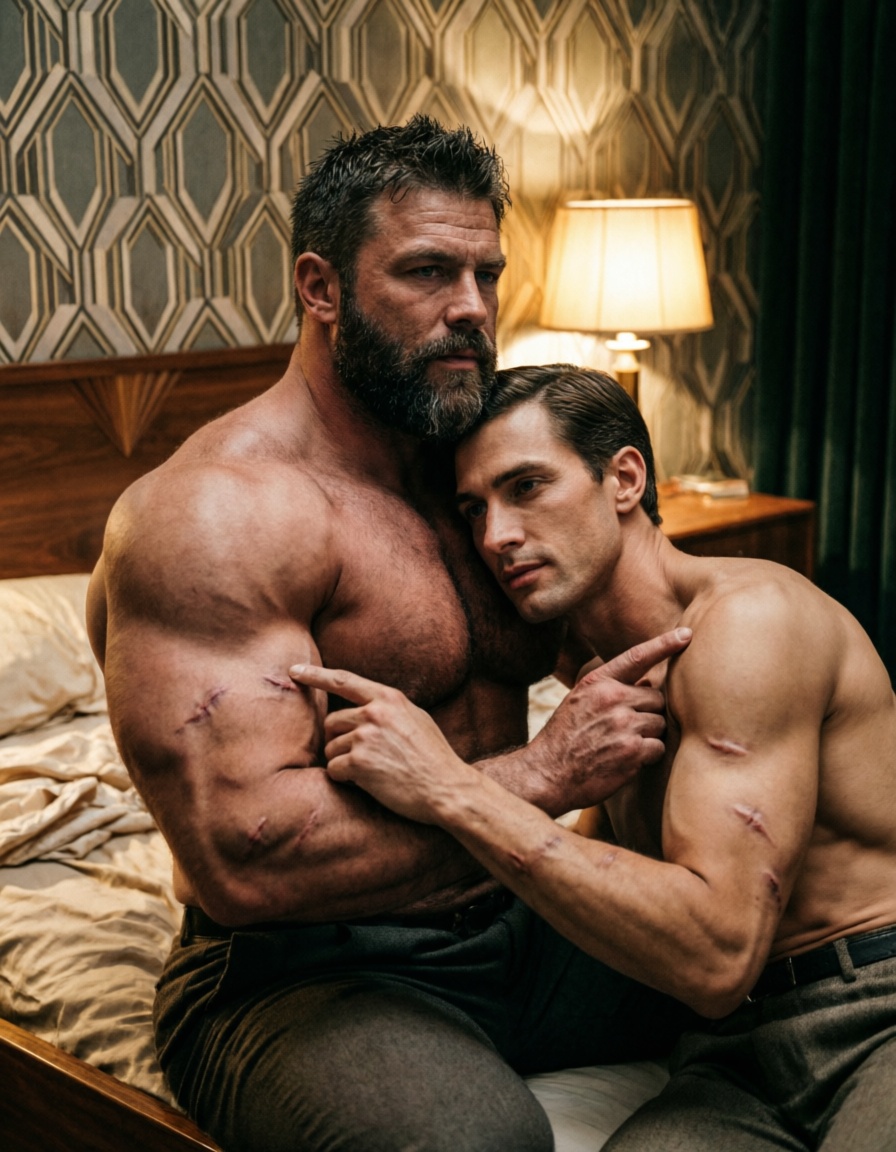
He imagined our future: a gym in Warsaw, local children allowed in for free, properly made weights, and me sitting in a chair that was too small, growling at anyone who neglected their legs.
Three days before the opening of the Games, Marek announced that he wanted to introduce me to some friends. We left the brightly lit avenues and entered a district of cellars, workshops and dark courtyards near Schlesisches Tor. The bar was called the Blaue Keller, although nothing inside was blue except the smoke drifting beneath the lamps. Sailors played cards with workers. A singer with a worn-out voice sang above the noise of the glasses. Two men were kissing in a corner that the owner pretended not to see.
Six athletes were waiting for us at the back of the room. They were German and Polish, all blond, muscular, young and almost aggressively handsome. Marek introduced them: Dieter, a swimmer; Hans, a wrestler; Otto, a rower; Paweł, a thrower; Stefan, a runner; and Emil, a gymnast.

-“This is Max,” Marek announced. “The British man who thinks he can lift Berlin.”
-“Only the interesting part,” I replied.
They laughed, but their eyes continued to evaluate me. They made me drink, compared their arms with mine and asked how I reacted to pain and how long I could fight after a maximum effort. The questions sounded like jokes between athletes. Yet I felt as if I were undergoing a medical examination.
A man in a brown shirt approached. His name was Rolf Brenner. The sides of his head were shaved, he had a heavy jaw, and his Nazi armband was clearly visible. He greeted several Germans, ignored the Poles, and stared at Marek.

-“Foreigners should know the place they are given in our city.”
Marek replied in Polish. I did not understand the words, but his tone was enough.
Brenner grabbed him by the collar. I stood up.
-“Let him go.”
He looked at my Party badge.
-“You are defending that?”
-“I am defending the man who shares my table.”
He hit me without warning. His fist split my lip. I stepped back, more surprised than hurt. The tables were pushed against the walls with strange speed. No one went to find the owner or the police. The six athletes formed a circle.
Brenner knew how to fight. He attacked low, aiming for my knees, then tried to blind me with the edge of his hand. This was not a bar fight but a test. I took two blows to measure his speed, blocked the third, and grabbed him around the waist

I lifted him, carried him to the bar, and threw him among the beer mugs. Glass flew through the air. He stood up almost immediately, his torn shirt revealing a chest covered with scars.

He stood up almost immediately, his torn shirt revealing a chest covered with scars. He tried to strike my throat. I lifted him, carried him to the bar, and threw him among the beer mugs. Glass flew through the air. He stood up almost immediately, his torn shirt revealing a chest covered with scars. His resistance was remarkable.
He charged. I turned and struck him with a short blow beneath the breastbone. The air left his lungs. Before he could fall, I caught him by the collar.
-“That is enough.”
He smiled despite the pain, spitting blood onto the floor.
-“Yes,” he said. “That is enough.”
His answer disturbed me more than the fight.
Marek cleaned my lip with his handkerchief. The others returned to their seats as if nothing had happened. In a mirror behind the bar, I saw the man with the newspaper. He was looking at his watch.Later, I understood that everything had been arranged: the insult, the circle, the refusal to call the police, even the length of the fight. Brenner had not come to provoke me. He had been ordered to measure my strength, my self-control and my ability to protect Marek.
That evening, however, I saw only one thing: Marek had trembled when the Nazi grabbed him, then thrown himself into my arms as soon as we left the bar.
I mistook his fear for love.
The First of August
The morning of 1 August 1936 was cloudy and humid. As the opening ceremony approached, the clouds cleared and the Olympic Stadium filled with nearly one hundred thousand people. Forty-nine delegations waited for their turn. The bands, flags and uniforms created a spectacle that was too perfect to be innocent.
I marched under the British colours. A few rows away, Marek walked with the Poles.

Hitler entered with the president of the International Olympic Committee, Henri de Baillet-Latour, and Theodor Lewald. Göring, Goebbels, Hess, Frick and Blomberg took their places in the stands. Leni Riefenstahl’s cameras moved along the delegations, searching for youth, power and order. Fritz Schilgen carried the flame. Rudolf Ismayr took the athletes’ oath. Finally, Hitler declared the Games open.
As I left the stadium, an officer from the Chancellery was waiting for me.
-“The Führer wishes to meet Champion Freaker.”
My first instinct was to refuse. Then I thought about the sentence in the message: “The secret weapon is not built; it is born.” No agent could have dreamed of a more direct invitation into the heart of the regime.
I followed the officer.
I was taken to a reception room beneath the stands. Hitler was meeting several German and foreign champions there. Riefenstahl was present with two cameramen. She asked me to stand near a window, where the light would show my shoulders more clearly. I understood that the meeting was less private than it appeared: they wanted to create an image of the regime being admired by a British athlete.
Hitler shook my hand. His grip was brief, almost weak. He looked up at me with a cold curiosity.

-“So this is the Austrian who lifts for England.
-“I am British,” I replied in German, “but I have not forgotten where I was born.”
Those were exactly the words my cover required.
He smiled.
-“Blood always remembers.”
The man with the newspaper stood to his right. For the first time, he introduced himself: Doctor Konrad Voss, scientific director of an institute of applied physiology. He had pale hands, a narrow face and steel-rimmed glasses.
-“Doctor Voss is interested in men who go beyond ordinary limits,” Hitler explained. “The future belongs to those who know how to preserve the best of what they have.”
-“And multiply it,” Voss added.
I felt the mission closing around me. I pretended to take his words as a compliment.

-“After your event, I would like to examine you. Your physique is unique.”
-“My coach says the same thing every time he orders my dinner.”
Voss gave me his card. He did not laugh.
Riefenstahl asked me to show my arms. I removed my jacket and rolled up my sleeve in front of the camera. Hitler placed a hand on my biceps. The cameras recorded the British champion smiling beside him. I kept smiling until my jaw began to hurt.

The Bar
My competition began on 2 August. In the changing room, my coach thought I was too calm. He did not know that I was thinking less about the weights than about Doctor Voss’s card hidden in my bag and the words spoken in front of Hitler. If Voss was directing the programme, I had to follow him. If he was interested in my body, I could join his project.
Marek received permission to remain near the warm-up area. He was wearing Poland’s white-and-red tracksuit. His smile had regained its brightness, but his hands kept twisting a towel.
-“Are you nervous?” I asked.
-“For you.”
My first bar went up easily. The second felt almost light. The crowd applauded when I held the weight steady above my head. I looked for Marek. He raised his fist and shouted something in Polish.
Between attempts, he handed me a bottle of water.
-“Drink. Your lips are dry.”

I drank without hesitation. The water had a slightly metallic taste, but the bottles at the stadium often did. Marek wiped my forehead and left his hand on the back of my neck for a second too long.
-“Whatever happens, remember that I love you,” he said.
-“Nothing is going to happen. Watch the next bar.”
I took three steps towards the platform. The room became distorted.
At first, I thought I had been blinded by the light. Then my legs became hollow. The voices moved away, the wooden floor seemed to move beneath my feet and cold sweat covered my back. I took hold of the bar. My fingers closed around it, but I could not feel the metal.I pulled. A weight I had lifted a hundred times remained on the floor. The crowd murmured. I released it, took a deep breath and tried again. The bar rose to my knees before slipping from my hands. I fell onto one hand. My coach rushed towards me.

-“Dizziness, Give me two minutes.”
I already knew that it was not dizziness. My vision was narrowing, my heart was beating too fast and my muscles refused to obey. Someone had drugged me. I looked at the bottle. Marek was still holding it. There was such deep pain in his eyes that I understood before he spoke.
-“Forgive me,” he whispered.
The officials announced my withdrawal. Marek insisted on taking me home instead of allowing me to be taken to the medical room. . My coach, worried about the scandal, agreed. Two men helped us into a black car. I recognised one of the athletes from the Blaue Keller behind the wheel.

During the journey, I fought to remain conscious. Marek held me against him, wiped the sweat from my face and repeated that everything would be all right. I could feel his chest trembling.
-“What did you put in the water?” I asked.
-“Not enough to kill you.”
-“How long?” I asked.
-“Max, save your strength.”
-“How long have you been working for them?”
-“They approached me. They knew about my family, my father’s debts and my brother, who had been arrested at the border. They promised to protect them. At first, I only had to undergo examinations. Then they asked me to meet certain athletes. Then you.”
-“Was the kiss beneath the porch part of the programme?”
He closed his eyes.
-“No.”
He took my hand. I wanted to pull it away, but my arm barely moved.
-“They threatened to kill my family if I refused. I thought I could warn you and make you leave Berlin. Then Voss understood how I felt. He used it.”
That was when I saw the syringe lying on the seat.
I gathered my strength and sat up. Marek grabbed the instrument and began to cry openly.
-“Do not do this,” I said.
-“If I do not, they will get into the car. They will break your bones to take you away. ”
-“And if you do it?”
-“You will remain whole.”
I reached Marek and closed my fingers around his wrist. Despite the drug, I could have crushed it. He did not resist.
-“I love you,” he said.
Then he drove the needle into my throat.The last thing I saw was Marek leaning over me, holding my face between his hands.
The Glass Men
I regained consciousness in a green light.
I was naked, strapped to a tilted metal table. Straps surrounded my wrists, ankles, chest, and neck. The air smelled of ether, hot rubber, and stagnant water. Above me, walkways crossed an enormous room. Two rows of glass cylinders stretched toward an armoured door. Human shapes floated in a cloudy liquid.

Doctor Konrad Voss stood near a control panel. Beside him, Marek wore a white laboratory coat that was too large for him. Voss was looking through a file.
-“The subject is conscious,” a technician announced.
Voss came closer.
-“Mr Friker. Your recovery confirms our estimates.”
I pulled against the straps. The metal groaned.
-“Where are we?”
-“In the future.”
-“I always imagined it would smell better.”
He watched the gauges instead of my face.
-“Your humour under stress is an interesting form of resistance. We will make a note of it.”
Marek took a step towards me. A guard stopped him.

-“I’m sorry, Max.”
-“You’ve already told me that.”
The lights inside the cylinders came on one after another. In the first, I recognised Dieter, the swimmer from the Blaue Keller. The second contained Hans, the wrestler. Then Otto, Paweł, Stefan, and Emil appeared. Their bodies were identical to those of the men I had met in the bar, down to their blond curls, their proportions, and the small marks on their skin.

Then the real athletes entered through a side door.
For several seconds, twelve men faced one another: six inside the glass, six on the walkway. The copies opened their eyes at the same time.

-“The secret weapon is not built,” I said. “It is born.”
Voss finally smiled.
-“So your government has our phrase. We were wondering how far the leak had travelled.”
I understood that my mission had also been part of their trap. They had allowed the message to reach London to attract a man who might interest them. My assignment, my cover, perhaps even my entry into the Games had all been planned.
-“Why athletes?”
-“Because they represent proven solutions. A champion’s body has already eliminated thousands of inferior possibilities. We are simply preserving the best.”
-“You’re creating twins.”
“No. We create series.”
He pointed to Marek.
“Subject M-27 allowed us to stabilise muscular growth and implant fragments of memory. But we were missing an organism exceptional in its mass, endurance, and controlled aggression. You.”
A door opened. Rolf Brenner entered, bare-chested and wearing only a pair of white trousers. There was no sign of the fight on his face.
Then a second Brenner appeared behind him.
The first still had a bruise beneath his breastbone. The second was unmarked. I understood which one I had fought in the bar.

-“Begin again,” Voss ordered.
My wrists and ankles were untied. Brenner came forward. I struck the unmarked model in the jaw. The bone cracked beneath my fist. He staggered, blood spraying from his mouth, then immediately came back and answered with exactly the same combination he had used at the Blaue Keller. He knew the fight because the other man’s memory had been transferred to him.I blocked him, seized him by the neck, and threw him onto the table. His head struck the metal with a dull sound. Three guards aimed their weapons. Voss raised his hand..

-“Perfect. Even in his weakened condition, he adapts his response.”
Brenner stood up again, his nose broken and twisted, blood running down his chest. He smiled as he had the first time, his teeth pink with blood.
-“That is enough,” Voss said.
They strapped me down again. Marek turned his head away.
-“Look at me,” I ordered him.
He obeyed.
-“Were you the one who chose me?”
-“Voss had chosen you before we met. I was only supposed to approach you.”
-“And now?”
His voice broke.
-“Now they are going to clone you.”
Mechanical arms descended from the ceiling. They shaved part of my chest and took samples of blood, skin, and bone marrow. Electrodes were attached to my skull.

Voss explained that physical matter was not enough. He wanted my reflexes, my muscles’ reactions, and the electrical pathways of my fear and my will.
-“We will remove what makes you weak,” he said.
-“What makes me weak?”
He looked at Marek.
-“Him.”
The Primary Model
The sessions lasted for hours or days. The light never changed. They put me to sleep, then woke me with electric shocks. They showed me flags, officers, and crowds raising their arms. A voice repeated that strength had value only when it served the State. Each time, I brought back into my mind Marek’s smile after his first successful clean, his mother’s biscuit tin, and the chair that was too small.

They believed those memories were a weakness. They became my holds.
Marek remained in the laboratory. Voss forced him to watch the procedures to punish him for his hesitation and to measure my reactions. When we were alone for a few minutes, he spoke to me without moving his lips.
-“There is a drainage tunnel behind the tanks.”
-“How many guards?”
-“Six at night. More during transfers.”
-“The main control panel?”
-“North walkway. The red lever opens all the chambers. The black one shuts down the cooling system.”
I did not know whether I could still trust him. Then I understood that the question no longer mattered. I could use his information without forgiving him.
In three nearby cylinders, my copies were growing at an impossible speed. They had my face, my chest, my arms, and a younger version of my beard. Voss called them F-1, F-2, and F-3. He called me Primärmodell—the primary model.

F-1 opened his eyes first. He looked at me, then turned his head towards Marek.
Voss wrote down the reaction.
-“Emotional residue,” he said. “We will correct it.”
That night, Brenner came to provoke me. The clone was now wearing a black uniform without any insignia.
-“You have been replaced,” he said, his voice nasal because of the nose I had broken. “Soon there will be a hundred Frikers. None of them will sleep with a Pole.”
I pulled against the strap around my right wrist. For several sessions, I had secretly rubbed its stitching against the edge of the table. It broke.

I seized Brenner and pulled him towards me before he could call for help. My forehead smashed his already broken nose. The bone gave way with a sharp crack. I took his key and freed my other hand. The alarm began to sound.
Marek ran towards the control panel. A guard struck him, but he remained standing and pulled down the red lever.
All the chambers opened.
Liquid spread across the floor. The copies of the athletes fell to their knees, blinded, then stood up. Some attacked the guards, tearing the weapons from their hands and breaking their arms with blows from their knees. Others remained still, waiting for an order. The six models from the Blaue Keller rushed out of a room and found themselves facing their doubles. No one knew whom to protect or whom to shoot.

I freed my ankles and charged at the first guard. My body was exhausted and covered in needle marks, but anger restored its memory. I broke his neck with a sharp twist, feeling the vertebra give way beneath my hands. I threw him against an electrical cabinet. The lights went out across half of the laboratory.
“The black lever!” I shouted.
Marek pulled it down.
The pumps screamed. A pipe burst above the tanks. Burning steam filled the walkway. Voss tried to reach an armoured door with his files. I caught him.
-“How many laboratories?”
-“You will never leave this place.”
I lifted him above the empty space, my fingers digging into his thin shoulders.
-“How many?”
Before I could question him further, a gunshot rang out. Voss went stiff. The real Brenner stood behind us, holding a pistol. The bullet had passed through the scientist.
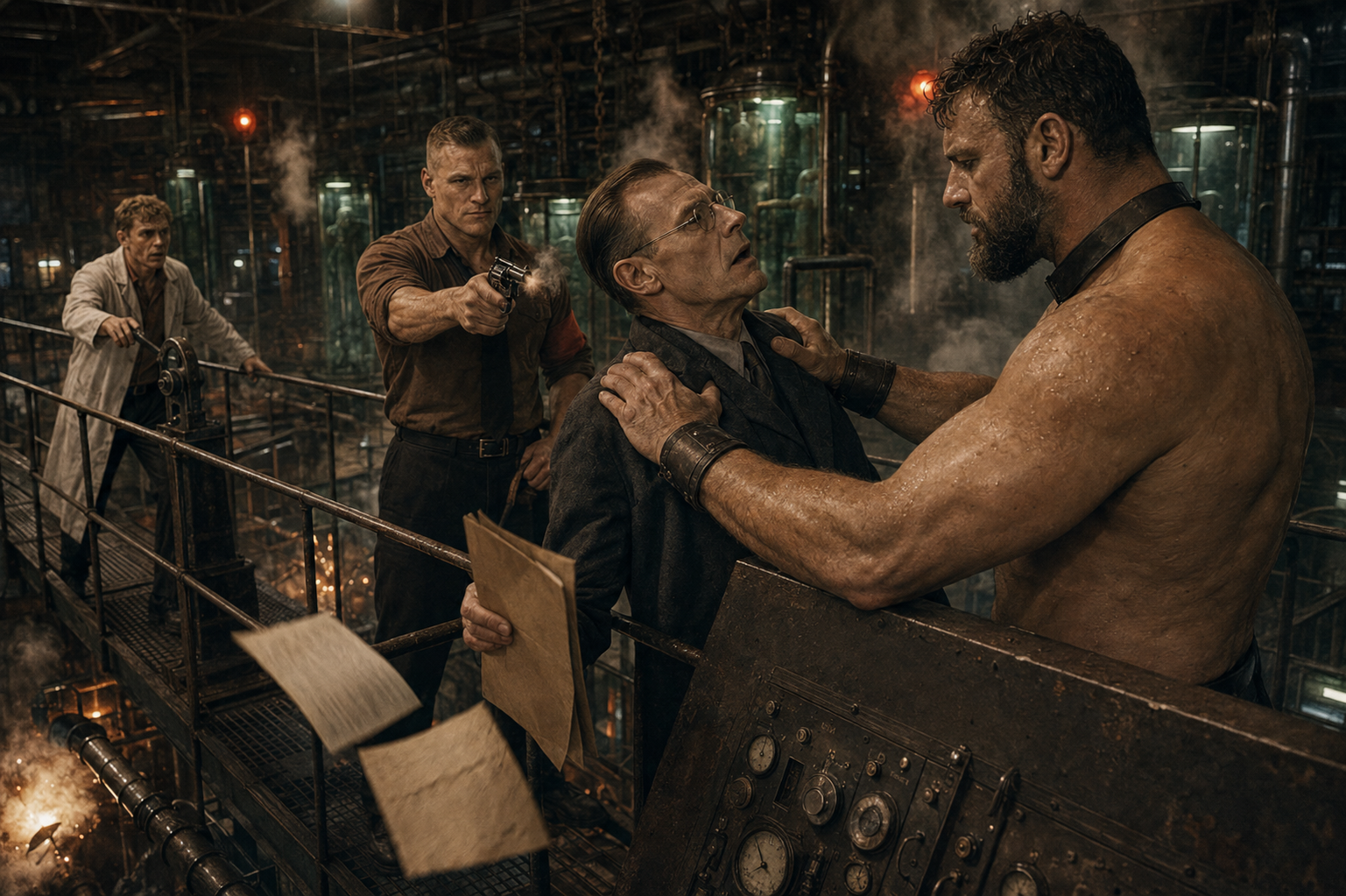
I dropped Voss and charged. Brenner fired again. A bullet tore through my shoulder, ripping flesh and muscle. I screamed but kept going, blood running down my arm. I struck him with my full weight. We went over the railing and fell onto a lower platform, five metres below. I landed on top of him and felt his ribs break beneath my weight.
He struck my wound, reached for my eyes, then tried to break my knee. He knew all my reactions because of the test in the bar.
But he did not know what I had learned about him.
I pretended to protect my knee, allowed him to move forward, then seized him beneath the arms. I lifted him like a barbell, held him above my head for a moment, then threw him against the F-3 cylinder. The glass cracked with the sound of breaking ice. The clone opened his eyes.

Brenner stood up again, spitting blood, several ribs pressing through his torn skin. F-3 broke through the glass from inside and stepped onto the floor. He had my face, but younger and uninjured.
-“Stop him!” Brenner ordered, his voice choked with blood.
F-3 looked at me, looked at Marek above us, then seized Brenner by the throat. He lifted him with one hand and watched him struggle, then tightened his grip. Brenner’s neck broke with a sharp crack. He dropped him like a puppet with broken bones.
-“Marek,” he said.
That single word decided our escape.
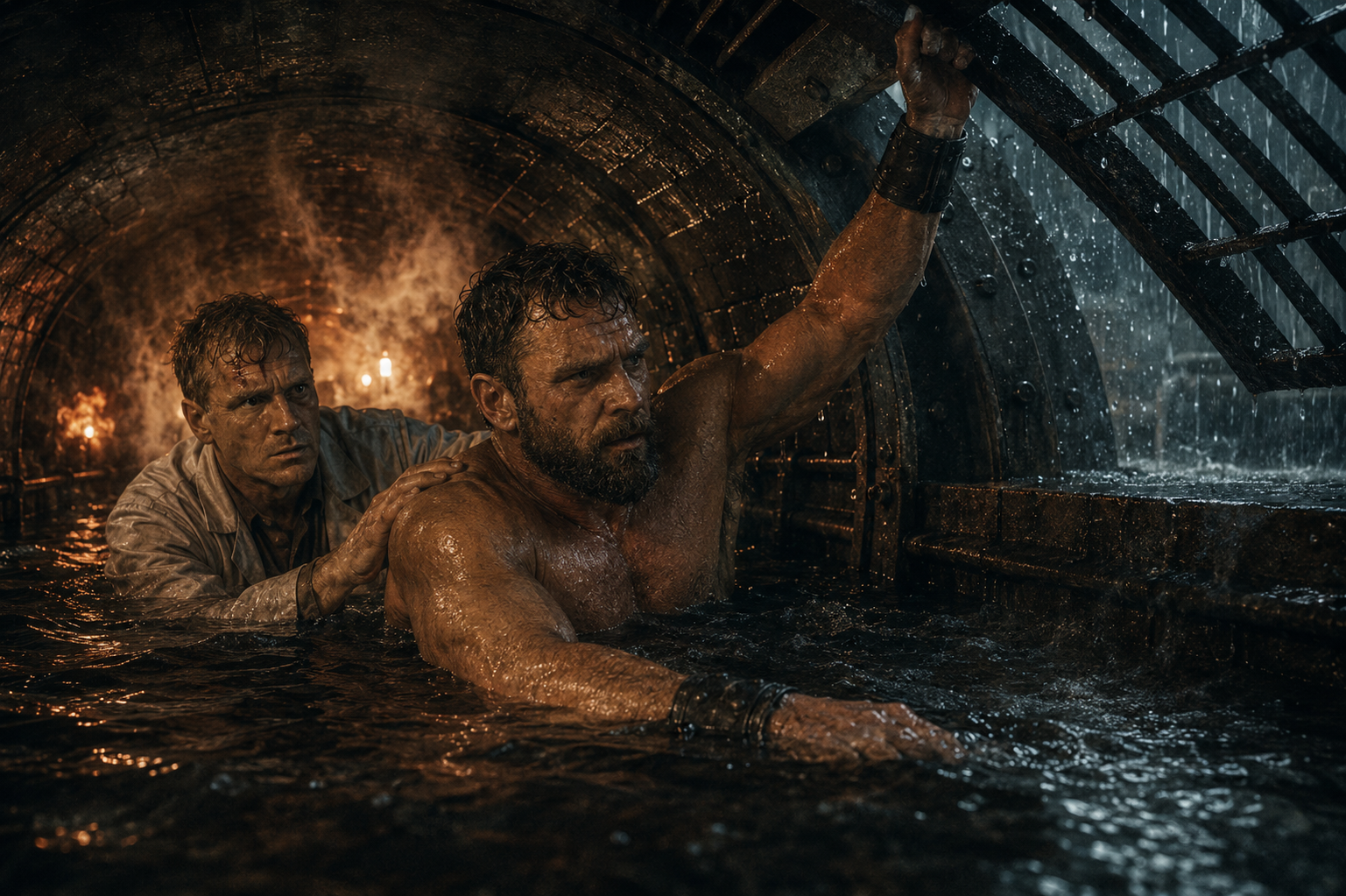
I returned to the walkway. Marek had been injured on the forehead, but he could still walk. We reached the tunnel behind the tanks as F-1 and F-2 tore themselves out of their chambers. Behind us, the clones overturned the machines. The steam reached the chemicals. A first explosion shook the ceiling, throwing debris and pieces of artificial flesh through the air.
-“You destroyed the cooling system,” Marek said. “Everything is going to burn.”
-“That was the idea.”
We crawled through black water. A second, more violent explosion lifted the outer grille just as I struck it. We emerged among the grass beneath cold rain.
The turbine factory burned behind us. Its windows exploded one after another.
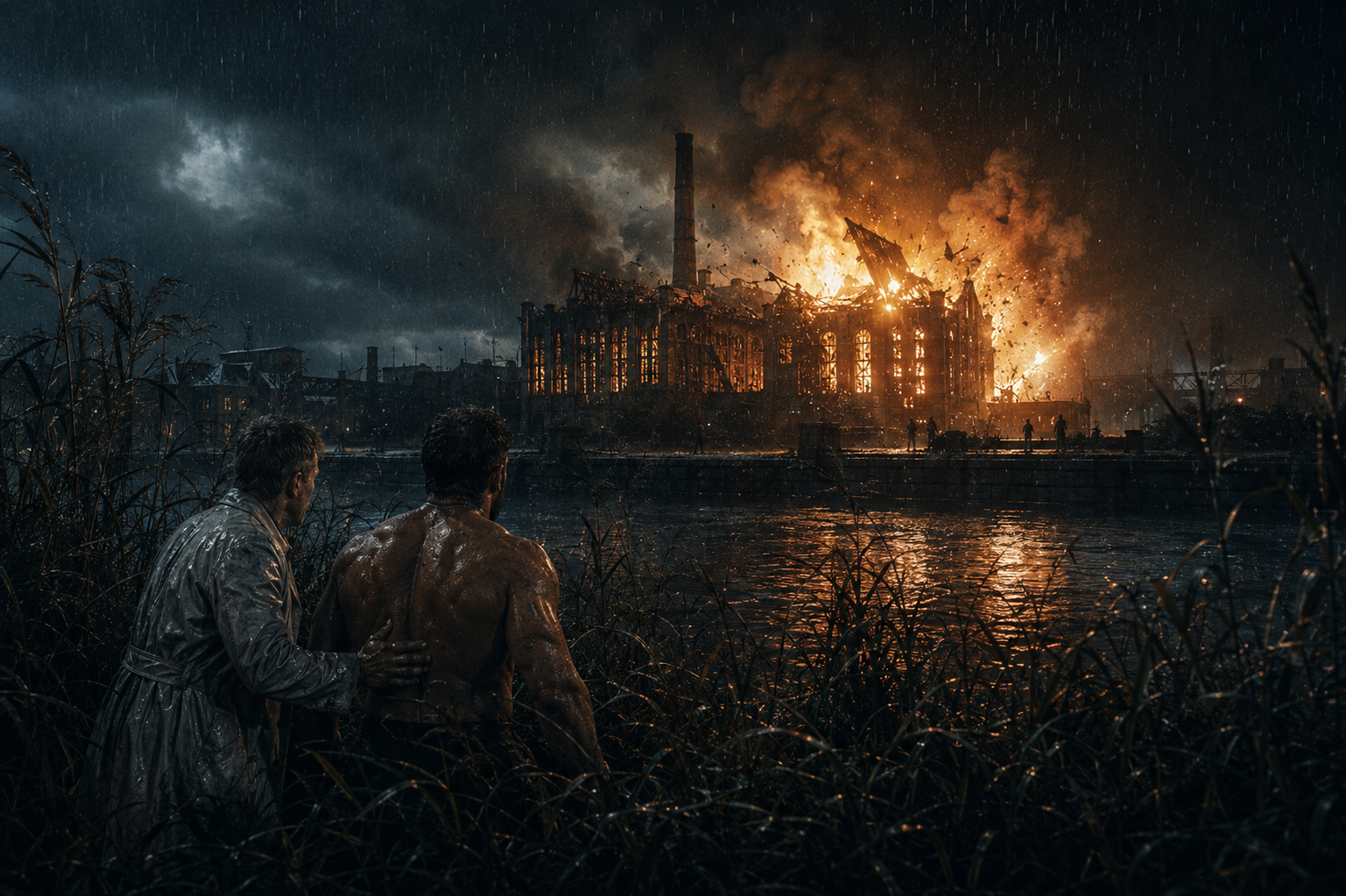
Figures came out through the doors, some naked, others in uniform, all resembling men the world believed were unique. I took Marek in my arms and ran away.
The First Clone
We found shelter in an abandoned shed before dawn. Marek had a cut on his forehead and burns on his hands. My wound was bleeding, but the bullet had passed through without breaking the bone. . I had suffered worse. I had never known anything more difficult than the silence between us.

He cleaned my wound with water from a tank.
-“You can leave me here,” he said. “The British will help you get out of Germany.”
-“They’re looking for you as much as they’re looking for me.”
-“That isn’t what I mean.”
I knew. He was asking whether our love had survived the syringe.
-“When you put the drug in the water, had you decided to hand me over?”
-“I had decided to save my family. Then I tried to reduce the dose. I thought you might still be able to lift, that you would understand and escape after the event. Voss was watching the bottle. He had placed a man near the platform.”
-“And the injection?”
-“I was afraid they would torture you. I made the choice for you.”
I could not forgive him in that shed. But I could not forget the man who had pulled the levers and opened the tanks either. I placed my hand on his.
-“We’ll get out of Berlin. After that, we’ll see what remains of us.”
-“The chair?” he asked with a broken smile.
-“It will always be too small.”
At midday, I went alone to a dead letter box used by London. I left a roll of film taken from Voss’s file, a map of the factory, and the names I had memorised. That same evening, a contact at the embassy provided us with clothes, false papers, and a car. Officially, Max Freaker had left the Games after suffering a nervous breakdown caused by his failure. Marek Zieliński had withdrawn for medical reasons. The propaganda machine preferred to erase failed champions rather than ask questions.
We left Berlin on 6 August in a truck carrying sports equipment. At the border, Marek slept against crates of weights. I looked at his hands, the hands that had caressed me, drugged me, treated me, and freed me.

London received my report. They congratulated me for destroying the laboratory and criticised me for disobeying almost every order. The photographs I had saved proved the existence of the tanks, the doubles, and the Voss programme. They convinced only a small number of men. Some called it a German deception. Others believed the technology could not work on a large scale.
I knew they were wrong..
For a while, we lived under new names in a house near Brighton. Marek learned English from the neighbourhood children. He trained in a shed where I had installed a barbell.

I recovered slowly. The drug had left me with tremors in my lft hand and a tiredness that I could not hide very well.
One night in December, a man forced open the door.
I heard him before he reached the stairs. I placed Marek behind me and waited in the darkness. The intruder entered the bedroom without turning on the light.
We fought. He knew my feints, my holds, and the way I protected my injured shoulder. Every move I invented, he seemed to have already imagined. His fist struck my face. I felt the skin above my eye split and blood run into it. I stumbled back against the wall and understood.

-“F-3?” I asked.
He stopped hitting me.
Marek turned on the lamp.
My own face appeared before me.

The clone was younger, clean-shaven, and almost naked beneath a stolen coat. A scar from the broken glass crossed his chest. His eyes moved from Marek to me. He placed two fingers over his heart.

-“Marek,” he said.
He had not come to kill us. He had been looking for us.
During the following weeks, we taught him to speak. He possessed fragments of my memory: the weight of a barbell, the rain in Berlin, the smell of the Blaue Keller, and the image of a chair he had never seen. He knew nothing about Graz, my mother’s face, or the reason I hated the red badge. He loved Marek with a love that had no history, implanted like a wound.
I then understood that I had not destroyed the programme. I had released its first perfect result.
London wanted to imprison and study him. I refused to hand him over. For the first time, Marek and I completely agreed. We arranged his disappearance before the agents arrived. When they searched the house, they found only a burnt photograph and three glasses on the table.
In 1939, the war began. Reports described identical soldiers in German units, men capable of continuing to fight despite mortal wounds. I returned to active service. Marek remained by my side, not because I had forgotten his betrayal, but because we had chosen to live after it.
As for F-3, he fought under several names. Sometimes, we received an unsigned letter. It contained only a clumsy drawing of a chair that was too small.

I had believed I was victorious when I watched the factory burn. I had believed I was the model when Voss wrote that word beneath my name. The truth was more disturbing: a model is not the only original man. It is also what continues when the original disappears.
Even today, I do not know how many men wear my face.
I know only this: they were able to copy my strength, my reflexes, and part of my memories. They never succeeded in deciding what we would do with that inheritance.
That is where their secret weapon failed. And that is where, perhaps, our story begins.
THE END
Published: 2026-08-30, viewed 113 times.
Tobias Hunter-Kane
18 days agoTrue to form, I am unfashionably late to the party. Max, I promised I would read this last week and finally did. DAYUM! It was well worth the wait! What an incredible blend of intrigue, love, betrayal, adventure, ambition, the quality of forgiveness, the questioning of what makes a soul unique or not. And the graphics made it all resonate so deeply. I have played with clone/doubles themes fairly often (shameless promotion - check out the Hunter Virus Files) but you presented such a different take on both clones and super soldiers. This was incredible, my friend. heartfelt congratulations on a job not only well done but superiorly done!
Oh and as a writer, sometimes a short passage expresses volumes. This stood out to me -"Voss gave me his card. He did not laugh."
Gregoryfight
21 days agoQuelle histoire Freaker.. c'est passionnant et intense. Bravo
Bad Cop Steve
21 days agoOh my sweet husband, your creativity is outstanding. I wish I could find a way to analyse your brain, although the findings might be scary haha. Bringing a controversial topic in a story is risky but you managed to pull it off. The story telling was incredible. Cloning is an interesting topic these days and has been for a while. Just like your name Freaker a freakish topic :) Next time we meet at home I will have to make sure i'm making out with the original Max hehe Well done my love!
Dream Breaker
23 days agoAfter reading this extremely interesting, well-written, and well-illustrated story, I was thinking to myself, what to say.
Our bodies, strength, and memories could be copied, but the control of the human capacity for choice, loyalty, love, and redemption, never.
Thank you for adding this unforgettable story on THE HIGH TABLE
BraveAjay
23 days agoNamaste - The story is a thrilling blend of espionage, romance, and science-fiction, combining high-stakes suspense with genuine emotional depth. Max and Marek’s relationship gives the adventure a powerful human core, while the mystery of the cloning program and its consequences keep the narrative exciting, imaginative, and memorable until the final page. Thank you for sharing your story on The Shelter.
Kad Royce
23 days agoRecognizing a masterpiece among simple good stories is not so difficult, as long as we know where to look.
First, there is the scenario: when a story manages to mix espionage, rivalry, a historical background and a touch of fantasy without ever losing its thread, we understand that we have already crossed a threshold. It is no longer just a successful story, it is an ambitious construction, almost virtuosic.
Then comes publishing, the way of shaping text and images so that the reader slips imperceptibly from one era to another. When the narration makes us believe that we have left 2026 to enter a movie of the 30s, with its shadows, silences and flashes of light, it is a second proof that we touch something rare.
Then there is the writing itself: precise, evocative, capable of bearing as much meaning as the images it accompanies. When a text manages to illuminate the action without ever burdening it, to suggest without explaining, to make people feel without demonstrating, then yes—one approaches genius.
As you will have understood: this story, I did not just like it.
I received it as a gift.
A shard.
A jewel.
Thank you, Max, for offering us works that still know how to surprise.