
Long Form Roleplayers
Established: 2021-04-21
Chat room: #long_form
- Long-term roleplay
- Descriptive writing
A space for fans of descriptive, long form roleplays of all genres to meet and greet one another
ASHES OF TROY


ASHES OF TROY
A Tragedy in the Spirit of Homer
DRAMATIS PERSONAE
TIMATHEOS — ACHILLES, greatest of the Greeks, terrible in beauty and in wrath.
BIG LUCAS — PATROCLUS, companion of Achilles, mighty in body and noble in heart.
MARCUS MERETRUS — A young Trojan warrior, son of a noble house, divided between blood and love.
TORYHE — Father of Marcus, veteran of Troy, iron-hearted defender of old law and old pride.
ATHENA — Grey-eyed goddess, protector of the Greeks, lover of cunning and victory.
APOLLO — Lord of light, protector of Troy, watcher of beauty, prophecy, and ruin.
CASSANDRA — Daughter of Troy, cursed prophetess, whose true words are always scorned.
THE CHORUS OF SOLDIERS — Greek and Trojan shadows, voices of fate, blood, memory, and grief.
PROLOGUE — THE FATHER WATCHES
(The theatre. A low golden light rests upon the audience .There is the rustle of cloth, the soft clearing of throats, the murmured gossip. FREAKER sits among them, broad-shouldered, silent, his hands rougher than the paper program he holds. He studies the stage as though it were a strange country, then lowers his eyes to the page.)
FREAKER
I never thought I would find myself here, seated among dreamers, breathing in the dust of velvet curtains and old wood, waiting for the dark to open and reveal what lives behind it. A theatre is not a place I know. I know halls, gyms, the blunt world of work and discipline, but not this. Not painted scenery. Not masks. Not men pretending to be heroes while lamps imitate the sun. And yet I came, because my son asked it of me without asking, because his voice has been full of this labor for weeks, because his hands have shaped something here, and a father, even when he does not understand, must sometimes come and look.

He always was like this, Lucas. He never desired peace as other men do. He desired fire. He desired noise. He desired the great beating heart hidden inside stories. While wiser people sought comfort, he chased intensity. While others learned how to fit within the world, he tried to seize it with both hands and force it to confess some secret beauty. The Dean says he is too loud, too untamed, too difficult to contain. I have heard this before, in one form or another, since he was young. Perhaps they are right. Perhaps a man must be excessive to make something worth remembering.
(Freaker opens the program, reading softly.)
Achilles. Patroclus. Marcus. Toryhe. Athena. Apollo. Cassandra. The Chorus. Troy.
So this is the war he chose. Not some small tale of lovers sighing in gardens, not some comedy to make the crowd laugh and forget itself. No. He has chosen the ruin of kings, the wrath of heroes, the fall of a city, and somewhere inside all that bronze and ash, he has hidden the ache of love. That is very much like him. If he cannot speak of the heart directly, he will place it on a battlefield and let it cry out among spears.
(Freaker looks up toward the stage.)
Very well, my son. Show me what you have built. Show me what kind of grief a young man must wrestle into shape before he can stand and call it art.
(The lights dim. The theatre vanishes into darkness.)
PROLOGUE — BEHIND THE CURTAIN
(Behind the stage. Shadows. Racks of costumes. The smell of dust, paint, sweat, oil, and wool hangs in the narrow space. BIG LUCAS stands half-dressed in the armor of Patroclus, his broad body glistening with a film of sweat, his chest rising and falling too quickly. Outside, beyond the curtain, the audience waits. MARCUS enters, already in costume, beautiful and restless, with the grave brightness of a man who feels too much.)
BIG LUCAS
Listen to them Marcus. Even when they are quiet, they make a sound like distant surf striking stone. A crowd always breathes like an animal. It waits. It listens. It judges. On the mat, before a wrestling match, I know that feeling well. The body grows hot and cold together. The hands seem too large. The mouth dries. The blood drums in the ears. But this is stranger, because when a match begins, there is no pretending. There is only force, balance, pain, timing, the truth of what one body can do against another. Here I must carry all of that and more. Here I must be not only myself, not only a wrestler, not only a man beneath the gaze of others, but Patroclus, beloved of Achilles, noble enough to wear another man’s glory and tragic enough to die in it.

I tell myself that I do not fear, because fear is a thin word and what I feel is thicker than that, something heavier, something that fills the limbs and sits beneath the ribs like a second heart. We built this thing together, you and I. With our endless hunger for myth, for old Greek words, with our love of stories that begin in splendor and end in smoke. With our bodies, knowledge of struggle, with the memory of every throw and lock and collision, with all the ways men test one another in the ring because they do not know how else to speak. We dragged Troy from books and fragments and turned it into flesh. We gave it shoulders, breath, sweat, jealousy, longing. And now it must stand or fall before them.
MARCUS
I am tied to this work as tightly as you are. I know how much of us lives inside it. You call me a lover of mythology, and I am that, but not because I worship the distant past like a relic in a glass case. I love myths because they lie less than ordinary speech. They take what men hide and make it large enough to be seen. In them, desire becomes a god. Pride becomes a city. Grief becomes a storm that can drown armies. That is why Troy was the right choice. It is not only about war. It is about the impossible things men try to hold when the whole world is built to tear them from their hands.
You are afraid because you care, and because what we have made is too near the bone. The others will see armor, hear speeches, admire the fall of heroes, but beneath that they will feel something rawer. They will feel two men reaching for one another across law, blood, and ruin. They will feel what it means to be seen by the wrong person at the wrong hour in the wrong world, and to love anyway. Let them. Let them see it. Let them call it dangerous.

BIG LUCAS
When we trained together at the university gym, when we learned each other’s balance and strength and stubbornness, I understood what it meant to trust another body. Wrestling teaches that. You put your weight into another man’s hands and dare him to betray it. You let him know the architecture of your force, and in return you learn his. But this was different, and the coach saw it long before either of us admitted it. Even our old Greek professor, with those patient eyes and that half-smile that always suggested he knew the tragic ending of every story before the first line was spoken, saw it too. He said that all great dramas are born when discipline fails to keep passion in chains. I laughed at him then. I do not laugh now.
If I tremble, it is because I know the crowd will not merely watch Patroclus die. They will watch a man walk toward a fate he understands too late, because love has made him brave and foolish in equal measure. They will watch another man lose him, and a city burn around that loss. And if I speak well tonight, if I make them believe, then perhaps for a little while the stage will become more honest than life itself.
MARCUS
Then go and be honest. Go and let them hear the truth. Go and let them see that the old world was not made only of kings and victories, but of hungry hearts trapped inside iron laws. I
(A distant drum sounds. The curtain trembles. They look toward the stage, and for one moment there is silence between them more intimate than any embrace.)
CHORUS

War has devoured ten long years. The winds of Aegea carry the scent of bronze and the sea’s salt, mixed with the sweeter, coppery perfume of spilled life. Troy still stands, a proud whore on the hill, defying the Greeks, her walls slick in memory with the blood of sons. The Greeks still rage below, a beast chained in the sand, its hunger sharpened by delay, its fury made hotter by frustration. Heroes seek glory as thirsty men seek water. But love, that most fragile and foolish of intrusions, has entered the camp like a lamp carried into a powder room. Its flame is small. Its consequences are not.
ACT I - THE SHORE OF FATE
(The scene : a lonely beach . The horizon is violet and bronze. The waves fold themselves again and again upon the shore,The sand is cool at the surface, damp and dark beneath. This is the remembered place of first collision. Marcus stands alone, stripped to the waist, his body luminous with strength, his broad shoulders and heavy chest catching the light like carved bronze warmed by breath.)
MARCUS
I have returned here too many times in thought. Here, before I knew your history or your allegiance, before I knew the names that would be attached to us like burdens, I met you in the oldest language two bodies possess. No priest stood between us. No herald announced us. No father approved. No city commanded. There was only challenge. There was only pride. There was the bright young arrogance of strength testing strength because the blood is warm and the world appears conquerable.
I remember how the wet sand gave slightly beneath our feet, how your skin gleamed where the sea mist touched it, how your arms locked around me with such confidence that I understood instantly why men followed you into danger. You fought with discipline, not like some wild brawler drunk on his own power, but like a man who knows the worth of restraint. That angered me at first. I wanted to break that calm. I wanted to prove that Troy still bred men as fierce as Greece. So I drove harder. I used every lesson ever beaten into me by my father’s stern instruction. I turned my weight, stole your center, forced the moment, and cast you down. And then you laughed.

Do you understand what a strange thing that was? I had expected resentment. I had expected wounded pride. Instead, you laughed. That laugh undid me more than victory did. It made room for tenderness before I had consented to feel any. It made danger desirable. When I bent over you and our mouths met, I felt not innocence but recognition. I knew then, with the miserable clarity, that this would not remain a passing thing. It had already become fate.
PATROCLUS
And I, who had seen men boast, seduce, threaten, flatter, and beg, had never seen anyone look at me as you did in that moment. Achilles sees the warrior in me. The army sees the steadfast companion. The enemy sees the Greek. But you, though you should have hated me most, saw the man. It is a terrible gift to be seen rightly by the wrong person in the wrong age. Terrible, and impossible to refuse.
Do not imagine that I gave myself to this lightly. The world we inhabit has no mercy for such crossings. Men speak of glory as it were the highest prize, but they reserve their deepest contempt for those whose hearts disobey the order of things. Had I desired you only in secret, had I wrapped that desire in silence and buried it beneath discipline, perhaps I could have preserved the shape of my life. But desire burns without light. So I chose, if choice it can be called, not to live in half-measures. If this was sin, then let it at least be honest sin. If this was ruin, let it be ruin embraced with open eyes.

When I kissed you there upon the shore, when the sea-wind moved over us and the world seemed for one suspended beat to forget its own divisions, I knew I was stepping out of one story and into another. I knew that I had reached the point beyond which there is no returning unchanged.
Ten years. Ten long and devouring years. Enough time for boys to become soldiers and soldiers to become ghosts. We came here in rage and certainty, in bright sails and brighter boasts, believing that a city could be broken as easily as a shield beneath a strong man’s heel. Yet Troy still stands above us, her towers proud against the sky, her walls shining by day like pale bone and by night. We have battered her gates, fed her fields with blood, blackened the mouths of her rivers with corpses, and still she endures. There are moments now when I think the city has become more than stone, that she has become a living thing, a queen standing in the wind and daring us to spend the last of ourselves in trying to drag her down.

And Achilles, greatest among us, sits apart from battle, wrapped in injured pride as in a cloak. While he withdraws, men fall. While he broods, ships burn. While he nurses the insult to his kingly heart, the Greeks stagger backward across the sand, and every retreat leaves another body face-down in the surf. I have stood beside him in combat. I know what it is to watch him move. He is not merely strong. He is catastrophe given shape, the clean and terrible will of destruction made beautiful enough to worship. But there are hours when worship is useless and duty must take its place. If he will not go, then I must go in his stead. If his armor must become a lie that saves lives, then let me wear that lie like truth and carry it into the storm.

MARCUS
When I first heard men speak of the Greek camp, they spoke of noise, stench, arrogance, and endless appetite. They said your warriors were like wolves who had learned to wear bronze, all hunger and fury and restless boasting. They said nothing soft could survive among you, nothing subtle, nothing human. Then I came here and found that war smells the same on both sides. Sweat does not change its scent, fear sounds the same in every throat. The night is equally cold to every exile from peace. And in the middle of that sameness, I found you.
You speak of duty, and I know that word. I was born beneath it. My father fed me on it with my first meat. I learned it in the training yard, in the courtyard of our house, in the long stare of the ancestors painted on the walls. Duty is the chain a noble house drapes around its sons and calls an inheritance. I was taught to carry it proudly. I was told that blood must answer blood, that a man’s body belongs first to his city, then to his father’s name, and only last, if there is anything left, to himself.

Yet whenever I stand before you, those teachings weaken. They do not disappear, and that is the misery of it. I do not become free when I am with you. I become divided. One half of me still hears my father’s voice, still sees the towers of Troy, still feels the pull of home and lineage and command. The other half, the half I did not know until the day the waves watched us struggle on the sand, reaches toward you as a starving man reaches toward warmth. Also, I fear that when I looked into the eyes of an enemy and found not hatred but recognition, the gods themselves leaned closer to hear what name that feeling would take. I fear that they heard it. I fear that they smiled.
PATROCLUS
Men are cruel enough without divine instruction. It is the world itself that made us enemies before we ever knew each other’s faces. It is the old greed of kings, the wounded vanity of princes, the hunger for glory that feeds upon the young and names the feast honor. When I met you, I did not think, Here is a Trojan. I thought, Here is a man who fights as though the sea were inside him, advancing and withdrawing in one rhythm, fierce and beautiful and impossible to predict. I thought, Here is someone who looks at me as though I am not merely a weapon in another man’s legend.
Then came the silence after force, the stillness that sometimes follows violence when the body knows before the mind that something has changed forever. I could feel the heat of you through the fading struggle. I could hear your breathing. And what happened then was madness, yes, but not accident. We crossed a boundary no soldier should cross and no enemy should ever desire. The same hands that had sought leverage sought tenderness. The same mouths that might have spoken insults found one another instead. I knew even then that such a beginning could only end in fire, and still I would not have undone it.
CHORUS

The sea looked on and said nothing. It has watched kings drown, lovers cling, fleets burn, children play, and cities reflect themselves in its mutable glass. It knows that men give different names to the same hunger. Contest. Desire. Curiosity. Fate. What begins in struggle often ends in surrender, and what begins in surrender often gives birth to forms of courage that even war cannot understand. They were enemies, yes, but enemies are often merely mirrors forced apart by banners. The sand remembered the shape of their bodies. The surf washed over their footprints. The sky darkened, and the world moved on, not yet aware that a city had already been wounded in a place no mason could repair.
ACT II — THE GOD AND THE FATHER
Scene I
(A high chamber in Troy, open to moonlight. Columns. Bronze lamps. Shadows long and cold. TORYHE stands alone. He is a man carved by campaign after campaign into something stern enough to frighten even those who love him. APOLLO appears in radiance touched with sadness, beautiful and terrible, the air around him trembling with golden light.)

APOLLO
Toryhe, defender of a city that has asked too much of its sons, listen now not as a commander but as a father. Long have you offered me smoke and wine, and long have I watched your spear rise in my cause. Therefore I do not leave you ignorant. The danger approaching your house does not wear armor alone. It does not come only from catapult, blade, or siege-fire. Your son has crossed a boundary more perilous than any gate. He has given affection where hatred was expected. He has opened his guarded heart to a Greek.
He has found in the enemy camp not merely an adversary but a man who has touched him where no command can reach. That man is Patroclus, companion to Achilles, beloved by many, essential to one. Through this bond your house stands in danger of shame, of fracture, of conflict not only within its walls but within the soul of your son. Decide carefully how you will answer it, for fathers often believe they are cutting out corruption when in truth they are cutting into living flesh.
TORYHE
God of light, your words strike more cruelly than an enemy’s spear. My son? Marcus? I have watched him since childhood, watched his shoulders broaden, watched his hand grow steady on sword and spear, watched the old Trojan fire kindle in him. I taught him to stand upright beneath the burden of our name. I taught him that a noble son belongs first to the dead who made him possible and second to the city that requires him. I taught him that tenderness is a luxury permitted only after duty is satisfied, and rarely then. Was all that instruction so weak? Was all that labor so easily overturned by the glance of an enemy?
A city at war cannot afford private madness. We are not shepherds in a valley free to follow our hearts where they wander. We are walls. We are lineages. We are obligations made flesh. If my son has forgotten this, then memory will be forced upon him. I will not permit the blood of my fathers to bend toward Greek contamination and call it love. Yet you warn me to tread carefully, and I do not ignore divine caution. Tell me this, lord of radiance: is he lost already, or is there still a path by which I may drag him back from disgrace?
APOLLO
I have spoken. The rest belongs to men, and men are seldom wise enough to handle the truths the gods reveal.
(Apollo fades. The light thins. )
Scene II — THE BATH
(The inner bathhouse of Toryhe’s house. Marble worn smooth by years of use. Bronze basins. Steam rising in ghostly veils. Water drips steadily from lion-headed spouts into a central pool that reflects wavering lamp-light. The room smells of cedar oil, wet stone, and the faint mineral sweetness of heated water. MARCUS enters, summoned. TORYHE sits already in the bath, vast and immovable as a carved idol.)
TORYHE
Come in. Do not stand there at the threshold like a servant called for punishment. You are my son, and I have not yet decided whether to speak to you as a father or as a judge.
(Marcus enters the water. The silence is long and oppressive.)

There was a time when this room held simpler meanings. You were a child then. I washed the dust of the courtyard from your limbs after training. I lifted you into the water when it seemed too deep. I watched the shape of the man to come reveal itself in narrow shoulders and proud eyes. You did not flinch from me then. You did not avoid my gaze. Yet now you move through the house like one carrying a secret wound, and your silence tells me more than confession would. I ask you, Marcus, not as rumor asks, not as enemies ask, but as the man whose blood made yours possible: what have you done?
MARCUS
If you ask because you already know, then the question is not mercy. It is ceremony. You want me to speak aloud the thing that has offended your pride. Very well. I have gone where I should not. I have felt what I was not taught to feel. I have met in the enemy someone whom I cannot reduce to a target or a curse. If you wish to call that weakness, then call it so. If you wish to call it betrayal, then name it loudly enough for the ancestors to hear. I am tired of pretending that words can make it less true.
TORYHE
You answer with defiance because youth always mistakes honesty for authority. Listen to me now, and do not interrupt. A man may feel a thousand things. Most of them must die unspoken if he wishes to remain a man among men. The heart is not a sovereign. It is an animal. It lunges toward warmth, toward beauty, toward whatever briefly softens the hard terms of existence. If we obeyed every impulse that rose in us, cities would collapse in a week and households in a day. Discipline is not the enemy of life. Discipline is the wall that allows life to continue. I have seen men on battlefields scream for mothers, lovers, gods, mercy, wine, oblivion, all within the space of a single mortal wound. Feeling is cheap. Endurance is costly. Duty is what separates lineage from chaos.
And now you tell me that amidst siege and starvation, amidst funeral smoke and the long shame of war, you have chosen to pour yourself into a Greek. Not just any Greek, but one bound to Achilles, one whose closeness to the greatest butcher in the enemy camp makes this offense doubly monstrous. Do you understand what follows if this is known? Mockery. Division. Weakness. A crack in the authority of my house. You do not merely endanger yourself. You endanger the meaning of everything to which you belong.
MARCUS
Everything to which I belong has spoken to me all my life, but none of it has ever asked who I am beneath those obligations. You speak of discipline as though it were a sacred cure for every human truth. It is not. It can shape a body. It can harden a will. It can teach a man to bear pain without complaint. It cannot command the soul to hunger only where custom permits. Do you think I wanted this because it was easy? Do you think I chose him because I despise Troy, or you, or the life that formed me? No. That would make matters simpler. I chose nothing. I met him, and something in me answered before law could speak. Every meeting after that only made clearer what the first had already written.
You tell me that feeling is cheap because on the battlefield men beg for many things. But what is truly cheap is the constant use of honor to disguise fear. You are afraid, Father. Not only for our house. Not only for Troy. You are afraid that there is something in me you cannot command, that all your teachings cannot root out, that love has entered where obedience once sat securely. That frightens you more than any Greek spear, because a spear can be broken, while another man’s inner life remains sovereign no matter how loudly he is threatened.
TORYHE
Enough. I did not summon you here to be lectured by the son I fed and armed. Hear me clearly, Marcus. Whatever this connection is, it ends now. You will not seek him. You will not receive him. You will not dream yourself into some private legend in which your passion ennobles your disgrace. The world is not made gentler because a forbidden thing feels beautiful. End this, or I will end it for you.
(Marcus rises slowly from the bath, water running from him like cold tears.)

MARCUS
Then perhaps ruin has already entered the house, and neither of us will choose how it leaves.
(Marcus exits. Toryhe remains, rigid, steaming in the silence like a statue that has begun to crack.)
ACT III — THE DEATH OF PATROCLUS
(The battlefield. Noon turned dark by smoke. Spears flash. Chariots scream across the plain. Dust rises thick enough to taste, bitter with trampled earth and blood. The clash of bronze is ceaseless, a monstrous music of impact, splintering wood, shouted commands, dying cries, and the dull wet sounds that come when metal enters flesh. PATROCLUS appears in the armor of Achilles, terrible and radiant, a false god moving through real slaughter.)
CHORUS
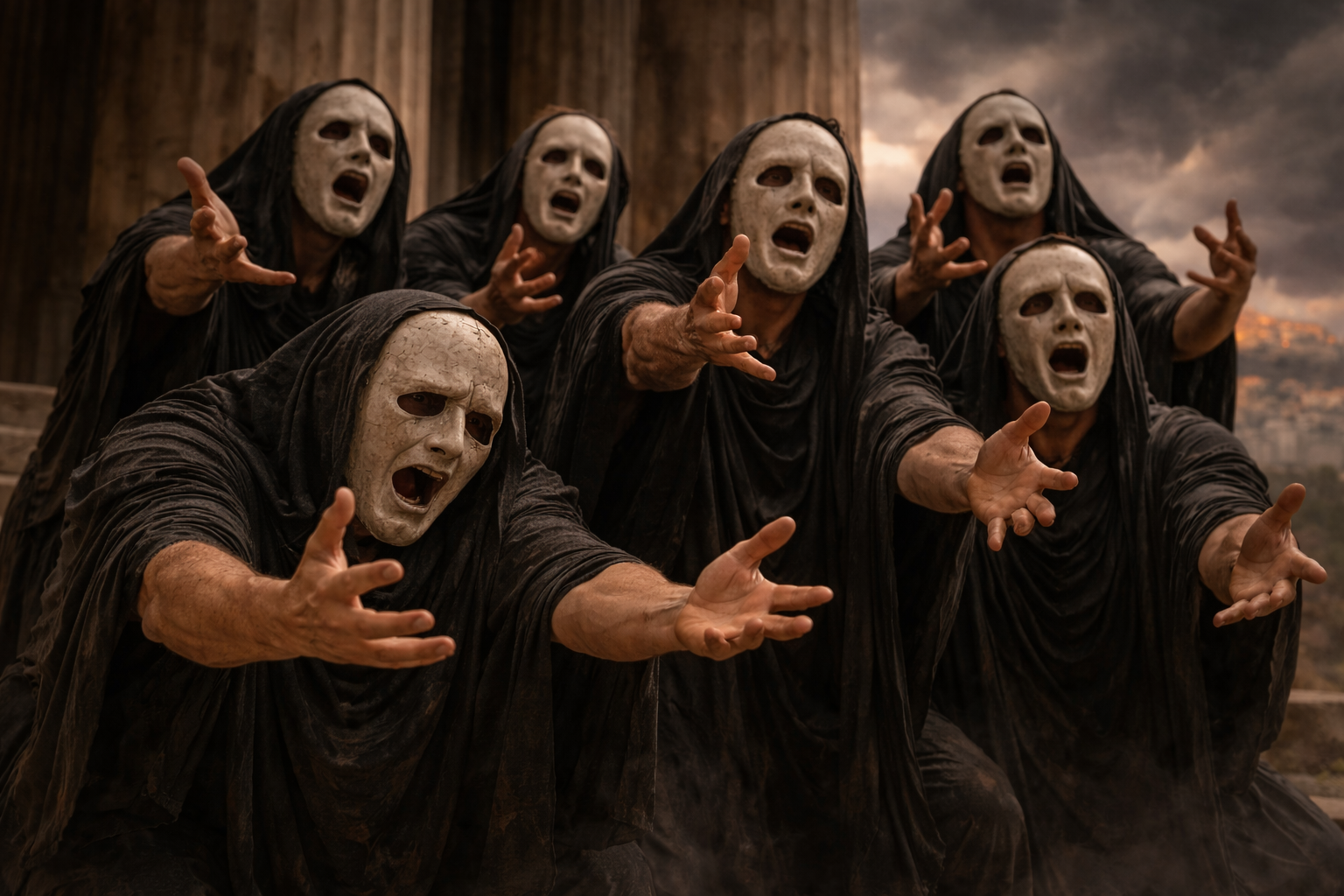
See how the borrowed splendor remakes the day. The Trojans, catching sight of that famous armor, feel a chill pass through them as if shadow had crossed the sun. Men do not always need truth in war. They need fear, and fear, once dressed in the right shape, does the labor of a whole army. Patroclus advances in bronze that is not his, yet courage within him is wholly his own. He does not wear deception out of vanity, but out of desperate mercy. He would save the ships. He would hold the Greeks together a little longer. He would spend himself where Achilles withholds himself. Noble intent is not a shield against fate. Often it merely marks a man more clearly for destruction.
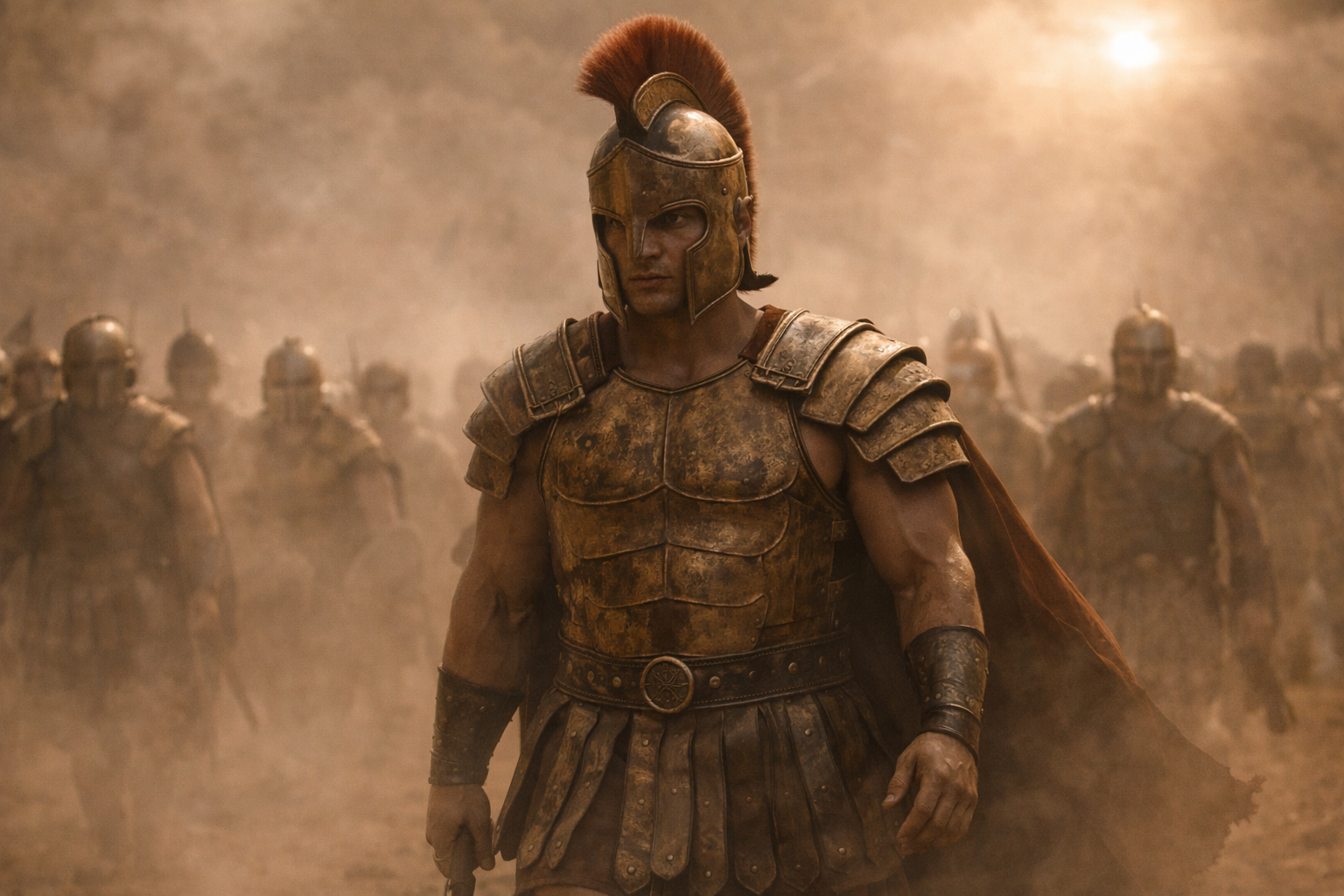
TORYHE
So there you are, gleaming in stolen majesty, wearing another man’s name upon your body. At first sight I thought the son of Peleus had returned to the killing-ground, and for one instant even my old blood cooled. Yet no, the stride is different, the rage too disciplined, the force too sorrowful. You are not Achilles. You are the companion, the loyal shadow, the man my son chose over his own blood. I should perhaps thank you for revealing yourself so splendidly, for making it possible to settle in daylight what should never have begun in secrecy.
PATROCLUS
If you know me, then you know also that I did not come here seeking your son’s disgrace. I came because men were dying by the hundreds and because the absence of one man had become a wound in the whole Greek host. Whatever exists between Marcus and me belongs to a realm deeper than your contempt. You may curse it, but you cannot unmake it with language. If you wish to strike me, strike me as an enemy soldier upon a field of war.
TORYHE
You speak boldly for one already half-dead. There is a serenity in men who have mistaken love for absolution. Hear me now as steel hears stone. I do not hate you merely because you are Greek. Greeks I have killed without remembering their faces. I hate you because you have placed your hands upon what was mine to shape. You awakened in Marcus a defiance that no father welcomes and no city can safely permit. You taught him to value his private hunger above lineage, above command, above necessity. You made softness appear heroic. That is your true crime.
PATROCLUS
No. My true crime, if crime it is, was recognizing his humanity where others recognized only his function. If that weakens the old order, then perhaps the old order was weaker than it claimed.
(They clash. The duel is brutal, dense, relentless. Toryhe fights like an old oak in a storm, rooted, methodical, savage in economy. Patroclus fights with breadth and momentum, every movement carrying the disciplined power of a man used to answering Achilles’ pace. Their blades strike sparks. Their shields slam. Their bodies crash together with the force of battering rams. Around them the wider battle seems to recede.)
CHORUS

Now watch how age and youth dispute each other in iron. Toryhe has the patience of old violence, the grim efficiency of one who has survived because he wastes nothing. Patroclus has the generous strength of a man who still believes his body may be spent for causes larger than himself. One fights to extinguish. The other fights to endure. Dust cakes their legs. Blood slicks their grips. The armor of Achilles rings under each blow like a bell announcing doom. Fate, hovering above them, requires no haste.

PATROCLUS
Ah—
(He staggers. Blood darkens the bronze.)
TORYHE
There. There is the truth beneath the splendor. Not god. Not invincible hero. Only flesh.
PATROCLUS
Flesh enough to have loved him better than fear ever could.
(Toryhe strikes again. Patroclus falls to one knee.)
Marcus… if any mercy remains in heaven or earth… do not let this make you less yourself.
(He falls. The din of battle seems for a moment to draw backward.)
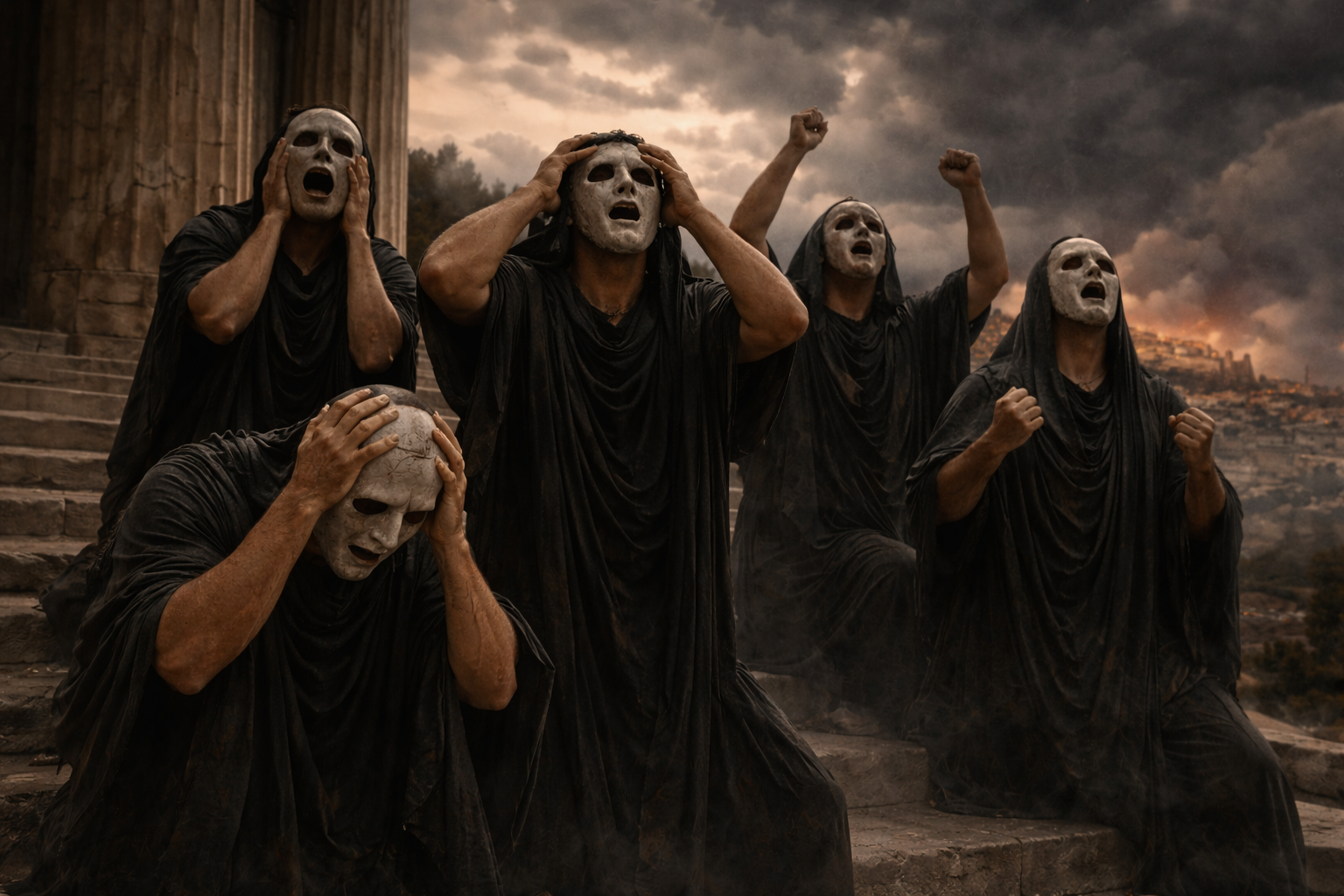
CHORUS
And thus he dies, not in the quiet of memory, nor in the private arms of the man who desired him, but in the filth and noise proper to war. The ground drinks him greedily. The bronze that made him appear a demigod cannot preserve the breath leaving his lungs. Somewhere, far off, Achilles still lives without knowing that the half of his soul entrusted to battle has just been cut away. Somewhere, nearer, Marcus feels the thread tighten before it breaks.
ACT IV — THE WRATH OF ACHILLES
Scene II - ACHILLES and ATHENA
(The Greek camp. Evening. The body of Patroclus lies in Achilles arms. He is terrible in stillness, as though motion itself fears what it would unleash.)

ACHILLES
When he breathed, the camp had a center I did not need to name. He was the calm inside my violence, the hand that knew when to restrain and when to release, the one man whose gaze did not reflect me as a monster or a miracle but as something more difficult and more human. Men praised my speed, my strength, my beauty in battle, yet none of them understood that he was the measure by which even those gifts remained bearable to me. Without him, all praise curdles. What is greatness when the only witness whose regard mattered lies silent before me? What is victory when the price has been exacted from the one life whose continuance I trusted without ever saying the word trust aloud?

They tell me he entered the field in my armor, and my pride should perhaps rage even at that, but pride is ash beside this. He went because I did not. He answered with his body the summons I refused in anger. Thus my wounded vanity has ripened into a coffin. Let every singer remember that. Let none of them polish it into noble abstraction. Men die because heroes are vain. That too is part of epic truth.
Who killed him? Speak plainly. Do not wrap the name in courtesy. Give it to me hard, as one gives iron to a smith.
(ATHENA appears in a cold blue-grey radiance visible to Achilles alone.)

ATHENA
It was Marcus, the Trojan youth. Love turns quickly to treachery among mortals. He lured him close and delivered him to death.
(A lie, or half-lie, shaped by divine strategy.)
ACHILLES
Marcus. Then let the walls of Troy hear me. Let the sky remember what sound wrath makes when grief gives it a name.
Scene II — THE CHALLENGE BENEATH THE WALLS
(The walls of Troy. The city looms high, pale and proud in the light of a merciless morning. Trojan and Greek armies gather below in suspended tumult. Every eye is turned toward Achilles, who strides forward in armor newly forged, blazing like contained lightning.)
ACHILLES
Marcus ! Come down from those walls if there is any courage in the love that has stained your name. Come down and face the man whose heart you have hollowed. You touched what was mine and sent it back to me cold. Do not hide now behind stone and father and city. Let us settle this beneath the eyes of both armies, and let whichever god still bothers to watch men choose whom he will preserve.
(MARCUS appears upon the wall, pale, stricken, grief-ravaged, about to answer. Before he can, TORYHE steps forward beside him.)

TORYHE
Hold your tongue, boy. Some burdens are laid upon sons ; others are seized back by fathers. Achilles, hear me. If you seek the hand that ended Patroclus, look not to Marcus. The blood on that death belongs to me. I struck the wound. I watched him fall. If vengeance is the coin you have come to collect, then you will take it from the proper chest.
MARCUS
Father, no. You have already destroyed enough.
TORYHE
Destroyed? Perhaps. Protected? Also perhaps. Men like us seldom know the difference until the ashes cool. But this much I know: I will not have my son butchered under open sky to satisfy the grief of Greece’s brightest wolf. If death comes for this house through Patroclus, it shall first take me.
ACHILLES
So the father confesses. Good. Better the truth arrive armored than remain hidden behind younger flesh. Come down, then, Toryhe of Troy. Bring all your age, all your pride. Bring the hand that cut Patroclus from the world, and I will teach it what it means to touch what I cannot lose and live.
Scene III — THE DUEL
(The armies draw back to form a vast ring of silence. Bronze glints. Standards stir. Horses stamp and snort. The wind carries dust, old blood, and the far smell of the sea. Above them, the gods incline their attention. APOLLO watches from Troy’s side in sorrowful brightness. ATHENA stands behind Achilles like sharpened thought made divine.)
APOLLO
Look, Troy, upon the consequence of all our splendors. Here is your veteran, stern and burdened, who believed that by striking at forbidden love he could preserve the architecture of honor. Here is the Greek avenger, radiant in grief, who mistakes annihilation for justice because grief leaves men no language broad enough to contain it. I favor the city, yes, but favor is not power over fate. Gods may warn, nudge, deceive, inflame, but there are hours when even Olympus must simply watch mortals complete the logic of their passions.
ATHENA
Speak your pity if you must, bright archer, but do not pretend that pity absolves weakness. Troy has stood too long beneath the shelter of illusion, and illusion now meets the blade. Achilles is my instrument not because he is morally pure, but because he is perfectly suited to the necessity of ending. In him grief and purpose are aligned. In such alignment lies terrible efficiency. Let the duel proceed. Wisdom is not always gentle. Sometimes it chooses the stronger hand and calls that choice order.
(Achilles and Toryhe meet.)

TORYHE
I have fought men younger than you, larger than you, wilder than you. I have seen champions come roaring into battle with sunlight in their hair and confidence in every stride, only to end face-down in mud because age knew where to wait and youth knew only how to rush. Do not think your fame frightens me. I know what stands before me: a bereaved man made dangerous by divine favor and by the simplicity grief grants. You loved greatly, perhaps. I do not deny it. But love does not excuse the ruin your people have poured upon this coast for ten years, nor does it place your suffering above all others. You would make my death a monument to your pain. I would rather make it a lesson—that even the greatest hero of Greece must bleed when he comes too near a father defending the remains of his house.
ACHILLES
You speak as the world still owes reverence to your authority. It does not. Whatever dignity age once granted you has rotted inside the choice you made. Patroclus entered battle in courage. You answered that courage not merely with force, which war permits, but with the cold satisfaction of one who believed he was correcting the soul of another man through slaughter. Do not clothe yourself in fatherhood. There is no sanctity in strangling your son’s heart and calling it discipline. You say I make a monument of grief. No. Grief has already made one of me. Every breath since Patroclus fell has been chiseling. Every moment has narrowed the world until only this remains: the man who killed him standing within my reach.

(They fight. Toryhe is formidable, shield-wise, economical, brutal in close range. Achilles is catastrophic—faster, cleaner, inhumanly precise. The combat lengthens into something nearly liturgical in its violence. Gasps move through the watching armies as bronze rings against bronze and sparks leap in little storms.)
CHORUS

Toryhe plants his feet as if he would root himself into Troy’s foundations. Achilles circles and strikes like wildfire driven by divine wind. One seeks to endure long enough for chance. The other seeks to erase chance altogether. Every blow speaks. Every block answers. On the walls, women clutch at veils and prayers. In the ranks below, soldiers who have survived ten years of war feel their mouths go dry as boys, because this combat gathers within it more than two men’s hatred. It contains father against avenger, order against appetite, shame against grief, and all the failures of speech that drive men finally to steel.
(Toryhe lands a heavy blow. Achilles stumbles, then returns with doubled force. A shield shatters. A shoulder opens. Blood runs.)
TORYHE
You are mortal after all.
ACHILLES
Only enough to make this sweeter for the gods.
(Achilles surges, breaks Toryhe’s guard, drives him to his knees.)
TORYHE
Marcus—
ACHILLES
Let his name be the last truth you taste.
(He strikes the killing blow. Toryhe falls.)
CHORUS

Thus the father dies before both armies, and silence rolls outward from his body like smoke from a fresh wound. Yet vengeance does not restore Patroclus. It does not unmake the beach, the bathhouse, the warning, the lie, or the blow beneath borrowed armor. It merely adds one more magnificent corpse to the account. Such is the poverty of revenge: it spends blood lavishly and purchases only continuation.
ACT V — ASHES AND DAWN
Scene I - THE HORSE
(Night over Troy. A strange stillness. The great wooden horse stands at the gates, immense and improbable, smelling of fresh-cut timber, pitch, rope, and hidden intent. Torches flare. Citizens gather in wonder and exhausted hope. CASSANDRA rushes forward, hair unbound, eyes fever-bright with the curse of truth.)
CASSANDRA
Do not touch it. Do not drag that polished doom across our threshold and call it victory. I have seen the inside of the gift. I have heard in dream the cramped breathing hidden in its belly. I have seen fire running along our rafters like red laughter. I have seen children wake to smoke, mothers stumble through collapsed courtyards, old men cut down not in battle but in chambers where they thought walls meant safety. You ask me always for prophecy and then despise it when it arrives stripped of comfort. Very well—here is prophecy plain enough for even the weary to understand: if the horse enters Troy, then death enters Troy walking upright.

MARCUS
All day the thing has stood outside the gates with the insolent calm of a puzzle that knows itself unsolved. The people want to believe. After ten years of fear, want is stronger than reason. They smell departure where I smell concealment. They hear surrender where I hear the held breath of a trap. Cassandra’s words strike me not because they are new, but because they give shape to the unease already coiling in my gut. We have all grown too intimate with deception in this war. We ought to know by now that gifts from enemies are merely ambushes in ceremonial dress. Yet my city is tired. Tired men invite disaster because disaster at least promises an ending.

Look at it. The horse towers above us with smooth flanks that catch the torchlight in warm curves, almost beautiful, almost sacred. The ropes around it are thick with tar and salt. The wheels groan softly whenever it shifts, as though wood itself resents the secret weight it carries. Children stare at it with awe. Warriors strike it with their palms and laugh. Priests search its proportions for omens they can survive. And all the while I feel the same dread I felt the day my father first looked at me with knowledge in his eyes. Something has already gone wrong. We are only waiting for the visible proof.
CHORUS
The horse smells of pine, resin, and deceit. It looms at the gate like a dream too large to trust. Hope drifts through Troy’s streets. Men choose to believe because belief is sweeter than vigilance, and after long misery sweetness can masquerade as wisdom. Cassandra cries out, but truth in an unwelcome mouth is treated as madness. So ropes are fastened. Hands strain. Wheels groan over stone. And with each turn of the axle, Troy draws its own knife nearer to its throat.
Scene II - THE FALL
(Fire. The city in ruin. Towers split. Roofs collapse in showers of sparks. The air is thick with cinders, smoke, burning cedar, molten bronze, blood, and the terrible animal smell of fear when safety has ended. Screams rise from every quarter, some sharp, some hoarse, some suddenly cut short. MARCUS moves through the destruction like a man walking inside his own nightmare.)
MARCUS
This is how cities die—not in one grand gesture worthy of sculpture, but in thousands of intimate violations. A door forced. A cradle overturned. A shrine blackened. A kitchen floor made slick with blood. A corridor where the old and young alike learn that stone walls cannot love them back. I thought grief had already emptied me when Patroclus fell and when my father followed him into death beneath the public sky. I was wrong. There was still depth left for Troy to tear open.
Here lies the house that shaped me. Here lies the name I resisted and still carried. Here lies the stern voice that wounded me and the city that demanded that voice exist. My father is dead. Patroclus is dead. The gods have had their feast and left us the bones. What am I now? Not the obedient son Toryhe hoped to preserve. Not the secret lover who believed a corner of tenderness might survive behind the walls of war. Not even fully Trojan any longer. I am remainder. I am witness. I am the man left standing after the old words have burned away.
Yet even here, among beams that groan as they collapse and streets red with reflected flame, I feel something endure that destruction cannot quite seize. Patroclus is gone, but what he awakened does not die with him. My father is gone, but the struggle he forced into me will travel onward in altered form. If the gods intended that only ashes remain, then they do not understand men as well as they suppose. Ash is what fire leaves when it finishes its speaking. But from ash one may still mark the skin, still remember the shape of what was consumed, still carry forward the proof that something once burned brightly enough to wound the dark.
(In the distance Achilles stands upon a shattered height, lit by the inferno below. He does not look victorious. He looks emptied beyond measure.)
ACHILLES
The city falls, and all the world will say that I have won. Let them say it. Let the poets build their polished songs from this red wreckage and call me glorious. They will not taste what I taste. They will not know the bitterness that lies beneath triumph when the one man whose praise mattered is absent from the feast. Troy burns magnificently, and I can feel nothing in the sight but fatigue. Revenge was a blade I sharpened on grief until I could no longer remember the shape of my own hands.

If this is greatness, then greatness is poorer than common men imagine. If this is immortality, it is a cold gift. My name will outlive me, yes. Men will teach boys to admire the speed of my feet and the terror of my spear. Yet somewhere beneath all that bronze praise, the truer story will persist in quieter mouths: that Achilles loved, that Achilles lost, and that the loss hollowed his victories until even the fall of Troy could not fill them.
FINAL CHORUS

So ends the city and not the sorrow. Fire devours cedar beams, painted chambers, bridal rooms, altars, and gates. The fathers are dead. The lovers are dead or parted. The gods have chosen, deceived, favored, watched, and departed in their shining remoteness. What remains to mortals is the burden they always keep after epics finish: to gather meaning from ruin and continue walking.
Remember them, then, not only as figures in bronze and legend, but as men caught between duty and desire, pride and tenderness. Remember the beach where struggle became recognition. Remember the bath where a father tried to drown truth in command. Remember the borrowed armor, the fatal wound, the challenge beneath the walls, the old man falling before the avenger, the horse rolling inward on its creaking wheels, Cassandra crying to deaf stone, and Marcus walking at last through ash toward an unwritten future.

EPILOGUE
The play ended in thunder. Applause rose like a storm, filling the university hall until even the old walls seemed to tremble with it. For one night, Troy burned again and lived. Achilles, Marcus, Cassandra, Patroclus… they were no longer students, but legends reborn beneath fragile stage lights.

But glory on stage does not silence the world beyond the curtain.The next morning, Lucas stood beside his father in the Rector’s office.The verdict was cold.Expulsion.For stealing a fraternity cup, “a relic,” they called it. But worse for fighting with a professor, a marine, hardened by real wars, not staged ones.

(Silence followed. Freaker did not look at him at first. Then...)
FREAKER
I gave you a future here.
BIG LUCAS
No. You gave me a role.I want something real. I’m going to enlist. Military academy. I’m done pretending to be a warrior.
The words hung between them. Outside, life continued.Inside, a different war had just begun....
Published: 2026-03-30, viewed 116 times.
RedBull
2026-04-28 17:35BRAVO!! Du MAX à son meilleur et où l'amour passionnel coiffe la violence de la guerre; enrobé dans un lyrisme qui élève la réflexion.
BRAVO!! MAX at his best, where passionate love triumphs over the violence of war; wrapped in a lyricism that elevates reflection.
BraveAjay
2026-04-03 06:58नमस्ते- Namaste, It feels difficult to add anything more than what has been said by these other great writers about your story, gentlemen. Your cooperation was smooth, bringing us something extraordinary to read. I am speechless. I can just say thank you and be grateful you shared your story on THE SHELTER.
Bad Cop Steve
2026-04-01 02:45Mind blowing, the story telling was so fluid, mixed with theatrics on stage and behind it. Thank you all for your contribution in this beautiful story telling tale. Always enjoyed and a big fan of the Greek mythology era, I appreciate how you brought it into modern times. Good luck Lucas with your new endeavours. I'm sure your dad is proud of you. Your dad is a great man! Well done all of you.
Austrian66 (deleted member)
2026-04-01 19:35(In reply to this)
Ir it is always nice to receive a good comment from Readers. Thank you to have taken time to let us know you liked our story.
Austrian
BIG LUCAS
2026-04-01 19:32(In reply to this)
Thank you sir. I m happy you liked our mythological adventure. I will try to keep my dad proud of me
Lucas
Dream Breaker
2026-03-31 08:27I confess. I needed to sleep on it before commenting on this story after reading it. This is the story taken to the other level, a story with many layers in it, each one of them telling its own story. There is the theater scene with love, battle, passion and tragedy that sometimes feels real while at the same time Real-life developments are unfolding. It also sheds light on the relationship between the son and his father but, above all, on Lucas’s true desires—perhaps a glimpse of his future. And once again, Lucas’s past experiences with his marine instructor resurface—an experience that seems to have given rise to some sort of obsession or idolization, toward which Lucas, with or without his father’s consent, intends to move forward.
Delicious writing, awesome illustration.. I am proud you wanted to share this masterpiece on THE HIGH TABLE!
Austrian66 (deleted member)
2026-03-31 09:47(In reply to this)
I met Lucas at my gym. Back then, he was a well-behaved but rather arrogant student. Now he's changed and chosen a new, more aggressive path. I think our play about Troy was the culmination of his decision to change his life. I hope he manages to find his voice. As for that marine, he should be careful. He's not the same Lucas he used to be.
Austrian
BIG LUCAS
2026-03-31 09:37(In reply to this)
Hello SIr great comment. Yes my life changed. I can wait to meet this arrogant marine again. And then he will see who i'm really
Lucas
Freaker
2026-03-31 08:55(In reply to this)
Thank you so much Alex. For a long time, iI wanted to do something about the Trojan war and i found in my son the perfect Patroclus and in Marcus the perfect lover who could take the place of Achilles. Yes you re right about the marine. I do not know yet if it was a good thing he met him. He changed redicaly his way of life. Andi hope he will chose the right path and make the right decision.
Max
BIG LUCAS
2026-03-31 09:40(In reply to this)
Hi Dad, don't worry about me, I know exactly where I'm going and what I want
Lucas
ErikAtlas
2026-03-30 20:05It's difficult to even remember the early days of cyber, when a post was made, not to tell a story or even provide a reader experience, it was more of a receipt that proved I kicked your ass. Every post back then I knew this could be so much more.
AND NOW we have this and I'm truly struck to awe. What an amazing production of stage in the frames of reality! I would seriously love to see this staged. The pathos of the Chorus, the handsome beauty of the lovers, the shimmering splendor of the Gods, and all acted and spoken in perfect passion. Of course this entry is added to my All Time Favorites.
I applaud the efforts of Timatheos, Marcus Meretrus, Big Lucas, Freaker, Austrian66 and everything they did in this amazing production. TRULY incredible!
BIG LUCAS
2026-03-31 07:08(In reply to this)
Sir; i loved my part in that play. Bad i had to die. But it was in the middle of hot guys so it was not to painful. Happy you loved our adventure.
Big lucas
ErikAtlas
2026-03-31 20:32(In reply to this)
You died well and I grieved your passing. You were beautiful. I look forward to your next effort, Bravo!
Austrian66 (deleted member)
2026-03-31 06:54(In reply to this)
Sir one of the best comment i received for my little contributions to CF. You made me blush, what at my age does not happen a lot. Max Freaker was a great advisor and i have to add, his illustrations are helping a lot to the good look of our group work.
Thank you so much and happy to be in your all time favorites
Austrian66
ErikAtlas
2026-03-31 20:33(In reply to this)
True story, Freaker is an inspired artist and storyteller - rare to ever meet one so good. Your performance was solid and true, I look forward to more, please. Bravo!
Freaker
2026-03-31 06:46(In reply to this)
Thank you so much Erik for reading and commenting my stories. Was one of my dream to write about the trojan war. I have to thank my co-wwriters who made the most part and followed my weird idea.
Max
ErikAtlas
2026-03-31 20:34(In reply to this)
The Trojan War was an event with so many unexplored angles of view and you found one that bleeds love and what war is to men. I'm in awe, thank you!